
Top 10 Proxy IP and Traffic Tools to Maximize Data Scraping Success
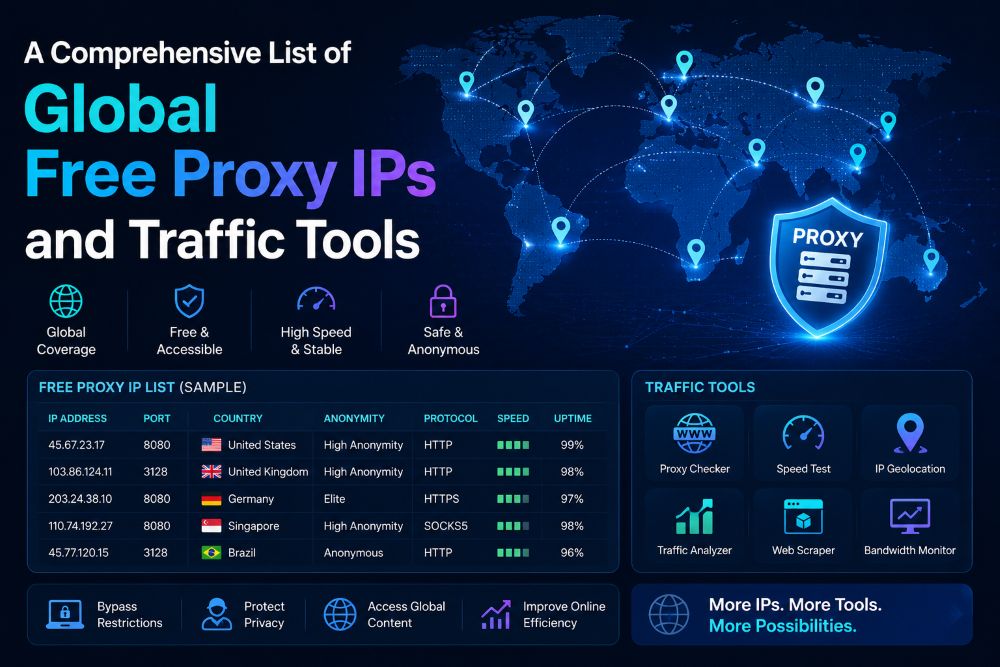
Free proxy IP lists are everywhere. Search for a few minutes and you will find pages showing proxy IPs by country, protocol, speed, anonymity level, and uptime. Some tools promise quick traffic routing. Others let you test IPs, check locations, rotate connections, or verify whether a proxy is still alive.
At first, this looks useful. If all you need is a quick way to test a page from another location, a free proxy may seem good enough.
But once the task becomes part of real work, the picture changes.
A free proxy IP that works for a few minutes may not be safe, stable, clean, or accurate enough for SEO monitoring, public web data collection, ad verification, e-commerce research, localized testing, or account-based workflows. The real issue is not whether a free proxy can connect. The real issue is whether you can trust the result.
This guide gives you a practical view of global free proxy IPs and traffic tools: what types exist, how people use them, where they fail, and when a business should move from free proxy lists to a reliable residential proxy solution like InstaIP.
1. What Are Global Free Proxy IP Lists?
Global free proxy IP lists are public pages that display proxy servers from different countries and regions. They usually include basic information such as country, IP address, port, protocol, anonymity type, and recent status.
These lists are popular because they are easy to access. Users can copy a proxy address, paste it into a browser, scraping tool, SEO checker, or proxy manager, and test whether it works.
Common free proxy list categories include:
- HTTP proxies
- HTTPS proxies
- SOCKS proxies
- Country-based proxy lists
- Anonymous proxy lists
- Transparent proxy lists
- Public rotating proxy sources
- Fresh proxy lists updated frequently
The problem is that “available” does not mean “reliable.” A free proxy may be online, but that does not tell you who controls it, who else has used it, whether the IP has poor reputation, or whether the location information is accurate.
For casual testing, free lists can be helpful. For serious business use, they create uncertainty.
2. What Are Free Proxy Traffic Tools?
Free proxy traffic tools are utilities that help users test, manage, or route traffic through proxies. They are often used together with free proxy lists.
Typical free proxy tools include:
- Proxy checkers
- IP location checkers
- Proxy speed testers
- Header checkers
- Browser proxy extensions
- Proxy switchers
- Traffic routing tools
- Basic scraping utilities
- Online anonymity checkers
- Uptime testing tools
These tools can be useful for learning how proxies work. They help users understand whether a proxy is alive, what country it appears to come from, whether the IP leaks information, and how slow or unstable the connection feels.
But traffic tools do not fix the core problem of free proxies. A checker can tell you whether an IP responds. It cannot guarantee that the IP is clean, safe, private, accurate, or suitable for repeated business use.
That is the line many beginners miss.
3. When Free Proxy IPs Can Be Useful
Free proxy IPs are not always useless. There are some low-risk cases where they may be acceptable.
3.1 Basic connectivity testing
If you only want to confirm whether a website loads from a different IP, a free proxy can help with a quick test.
3.2 Learning how proxy settings work
Free proxies can be useful for beginners who want to understand ports, protocols, IP routing, browser configuration, and request headers.
3.3 Non-sensitive one-time checks
If the task does not involve accounts, private information, business data, or important decisions, a free proxy may be fine for temporary use.
3.4 Tool testing
Developers may use free proxies to test whether a proxy field, proxy switcher, or network setting works before connecting a real provider.
The key is to keep expectations realistic. Free proxy IPs are better for learning and testing than for production workflows.
4. Where Free Proxy IPs Usually Fail
Free proxies often fail in ways that are not obvious at first.
4.1 Stability is unpredictable
A free proxy may work now and disappear later. Public proxies are often overloaded, blocked, slow, or abandoned. If your workflow depends on repeatable access, this becomes a problem quickly.
4.2 IP reputation is often poor
Many free proxy IPs are used by unknown users for unknown activities. Over time, they may collect a weak reputation. Websites may already treat them as suspicious, restricted, or low-trust.
4.3 Location data may be inaccurate
A proxy list may label an IP as one country, while the actual routing or database result points somewhere else. For SEO, ads, e-commerce, and market research, wrong location data can lead to wrong decisions.
4.4 Security is unclear
A proxy sits between you and the website you visit. If you do not know who operates that proxy, you should not send sensitive traffic through it.
Free proxies are not suitable for business accounts, dashboards, customer data, payment-related workflows, or private research.
4.5 There is no support
When a free proxy fails, there is no provider to help. No onboarding. No troubleshooting. No workflow guidance. No accountability.
5. Free Proxy Lists vs Managed Residential Proxies
The difference between free proxy IPs and managed residential proxies is not only price. It is control.
Free proxy lists give you public access with many unknowns. Managed residential proxies give you a more structured environment for business workflows. A residential proxy solution routes traffic through IPs associated with residential networks. For many use cases, this creates a more natural access environment than public proxy lists.
A managed residential proxy solution can provide:
- better IP quality
- more reliable sessions
- useful geo-targeting
- rotating or sticky session options
- technical support
- cleaner workflow planning
- more predictable access
- business-friendly setup guidance
6. Practical Use Cases: Which Option Fits?
6.1 SEO monitoring
If you only want to test one keyword once, a free proxy may be enough for a rough check. But if you need accurate regional rankings, SERP features, competitor visibility, and repeatable checks, a managed residential proxy is a better fit.
SEO decisions depend on trustworthy data. Unstable free proxies can distort that data.
6.2 Public web data collection
Free proxies can be useful for testing whether a data script supports proxy settings. But for repeated public web data collection, they often fail due to poor stability and weak IP reputation.
Managed residential proxy access is better for workflows that need consistency, location flexibility, and controlled rotation.
6.3 Ad verification
Ad teams need to see how ads, redirects, landing pages, and offers appear in target regions. A free proxy with inaccurate location data can make the verification useless.
A residential proxy setup with region targeting gives teams a clearer view of what users in a market may actually see.
6.4 E-commerce research
E-commerce pages often change by region. Pricing, product availability, shipping options, reviews, and promotions may vary.
Free proxies can help with rough exploration, but they are not ideal for ongoing market research. A managed residential proxy is more reliable for repeated regional checks.
6.5 Account-based workflows
Free proxies are a poor choice for account-based work. If a workflow involves login sessions, dashboards, team operations, or long-term access, unstable IPs can create unnecessary friction.
7. How to Evaluate a Free Proxy Tool Before Using It
If you still want to test free proxy IPs, evaluate them carefully.
7.1 Check whether the proxy is alive
A proxy checker can confirm whether the IP responds. This is only the first step.
7.2 Check the real location
Use an IP location tool to confirm whether the proxy appears in the country or region you expect.
7.3 Test speed and consistency
A proxy that loads one page slowly may not be useful for repeated tasks. Test more than one request.
7.4 Avoid sensitive traffic
Never use unknown free proxies for accounts, private dashboards, business data, or anything confidential.
7.5 Watch for repeated failures
If you spend more time replacing proxies than doing the task, the free option is already costing you time.
8. Signs You Have Outgrown Free Proxy IPs
Free proxy lists are often a starting point. They should not become the foundation of a serious workflow.
You have probably outgrown free proxies if:
- you need the same workflow to run repeatedly
- you care about regional accuracy
- you use proxies for SEO, ads, e-commerce, or data collection
- you need stable sessions
- you manage account-based workflows
- your team wastes time replacing failed IPs
- your results affect business decisions
- you need support when something breaks
9. Why InstaIP Is a Better Fit for Business Workflows
InstaIP is designed for users who need more than random free proxy IPs. It provides residential proxy solutions for business workflows that require stable access, location flexibility, and practical session options.
InstaIP can be useful for:
- SEO monitoring
- public web data collection
- ad verification
- e-commerce research
- localized testing
- cross-border operations
- account-based workflows
- market research
Instead of relying on public proxy lists, teams can use a more structured residential proxy setup with better IP quality, support, and workflow consistency.
10. Final Thoughts
Global free proxy IP lists and traffic tools can be useful for learning, testing, and quick non-sensitive checks. They are easy to find and simple to try.
But for business workflows, free proxies often create hidden costs: unstable access, poor IP reputation, inaccurate location data, security uncertainty, and wasted time.
If your team needs accurate regional visibility, stable sessions, clean IP access, and support for repeated business use, a managed residential proxy solution is the stronger long-term choice.
Visit https://www.instaip.net/en to explore InstaIP residential proxy solutions and click to claim free trial qualification.
11. FAQ
Q: What are global free proxy IPs?
A: Global free proxy IPs are publicly available proxy servers listed by country, protocol, port, and status. Anyone can try them, but their quality, safety, and reliability are often uncertain.
Q: Are free proxy IPs safe for business use?
A: Free proxies are not recommended for sensitive or business-critical workflows because ownership, traffic handling, IP reputation, and stability are unclear.
Q: Can I use free proxies for SEO monitoring?
A: You can use them for rough testing, but they are not ideal for serious SEO monitoring. Accurate regional search data requires more reliable IP quality and location consistency.
Q: What are proxy traffic tools?
A: Proxy traffic tools help users test, switch, route, or inspect proxy connections. Examples include proxy checkers, IP location checkers, speed testers, browser proxy extensions, and traffic routing tools.
Q: When should I stop using free proxies?
A: You should stop using free proxies when you need repeatable results, accurate locations, stable sessions, business data quality, or support.
Q: Why choose a residential proxy instead of a free proxy?
A: A residential proxy provides a more reliable and business-friendly network environment, especially for SEO, public web data collection, ad verification, e-commerce research, and localized testing.
Q: Can I test InstaIP before committing?
A: Yes. Visit https://www.instaip.net/en and click to claim free trial qualification.