
Static Residential IP
I. Why Do “Static Residences” Also Need IP Thinking?
For a long time, residential housing has been regarded as a highly functional product—designed primarily to provide shelter, basic living conditions, and physical comfort. However, as market conditions evolve and user aesthetics and consumption psychology mature, housing that merely fulfills functional needs is rapidly losing its competitive edge.
Today, users are no longer focused solely on layouts, square footage, or configurations. Instead, they are increasingly asking deeper questions:
- What kind of lifestyle does this residence represent?
- Does it carry lasting aesthetic value and cultural identity?
- Can it create a stable emotional connection rather than a one-time transaction?
It is precisely within this context that the concept of “Static Residential IP” has been repeatedly validated.
It is not simply a design style or visual label, but a systematic approach that treats housing as content, symbol, and spiritual carrier.
II. What Is Static Residential IP? It Is Not the Same as “Looking Good”
1. The Essential Definition of Static Residential IP
Static Residential IP does not refer to operation-driven real estate, nor does it rely on frequent events or continuous traffic stimulation. Instead, it focuses on:
Using architectural form, spatial logic, design language, and cultural core to allow the residence itself to become a recognizable, communicable, and sustainably appreciating “fixed content asset.”
What it emphasizes is “housing as IP itself,” rather than “housing + IP.”
2. The Fundamental Differences Between Static Residential IP and Conventional Housing
From a deeper perspective, the distinction between conventional housing and static residential IP is not about design quality alone, but about different levels of value cognition.
Traditional housing prioritizes function and practicality, aiming to answer questions such as “Is it usable?” and “Does it meet standards?” Its design logic is driven by compliance, efficiency, and standardization. Once construction and delivery are completed, the value of such projects often stabilizes or gradually diminishes.
Static residential IP, by contrast, begins with emotional resonance and identity. It does not rush to showcase features or specifications, but instead asks: What does this place stand for? Through the deliberate creation of memory points and a unified design language, it becomes instantly recognizable and emotionally legible.
In terms of user relationships, conventional housing typically represents a transactional exchange. Static residential IP, however, seeks to establish long-term identification. The bond between user and space deepens through daily use, driven not by operational interventions but by the spatial experience itself.
At the brand level, traditional housing projects often exist independently, requiring new recognition from scratch each time. Static residential IP, once established, becomes extendable and reusable, allowing subsequent projects to inherit accumulated brand equity.
Ultimately, this difference is reflected in lifecycle value. While conventional housing reaches value completion upon delivery, static residential IP continues to grow through time, as aesthetic durability, cultural meaning, and emotional attachment are continuously rediscovered and reinforced.
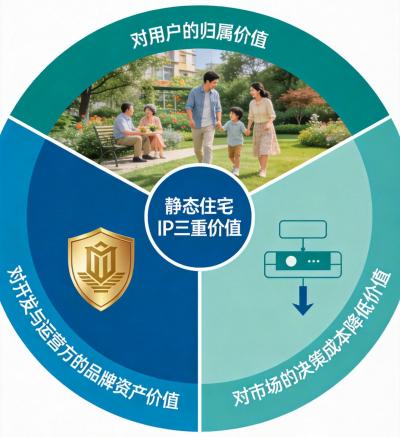
III. The Three Core Values Created by Static Residential IP
1. For Users: From “Living” to “Belonging”
Truly successful static residential IP achieves one crucial outcome:
it creates a sense of emotional attachment—“this is my place.”
Such residences typically share common characteristics:
- A highly unified spatial language that avoids aesthetic fragmentation
- A clear spiritual theme, such as nature, order, humanity, or a sense of calm
- Living experiences that withstand time, rather than offering short-lived visual impact
When housing becomes an emotional carrier, users naturally become its advocates, protectors, and storytellers.
2. For Developers and Operators: Building Sustainable Brand Assets
The value of static residential IP extends far beyond a single project. It lies in:
- Replicable design systems
- Extendable stylistic identifiers
- Accumulative brand recognition
This allows each new project to build upon existing brand momentum instead of starting from zero awareness.
3. For the Market: Lower Decision Costs, Higher Conversion Efficiency
In a highly homogenized residential market, the greatest advantage of IP-driven housing is instant recognizability.
When users can immediately understand a project’s tone, philosophy, and value orientation without repeated education, conversion naturally occurs along a much shorter decision path.
IV. How Is Static Residential IP “Designed”?
Layer One: Unity of Architectural Language
IP must first be visible.
Facade proportions, material selection, and rhythmic lines must all serve a single narrative goal, rather than resulting from fragmented or collage-based design.
Layer Two: Logical Spatial Order
A strong static residential IP always has a distinct spatial character:
- Clear hierarchy between public and private spaces
- Circulation that aligns with intuitive behavior
- Ritual-like experiences formed naturally through daily use
These details determine whether a residence can endure long-term living.
Layer Three: Subtle Integration of Culture and Emotion
Truly advanced IP never declares its cultural depth explicitly.
Instead, it influences residents subtly through proportion, negative space, light, and rhythm—quietly shaping emotional perception over time.
V. Why Static Residential IP Is Especially Suited to the Current Market
1. The Decline of Traffic Dividends and the Return of Long-Term Value
Short-term hits are becoming increasingly difficult to create, while stable value is being re-embraced. Static residential IP aligns perfectly with this shift—slow, steady, and enduring.
2. Maturing Aesthetic Awareness Among Users
More users can now distinguish between superficial “design sense” and genuine design depth, allowing systematized residential IPs to stand out.
3. Changes in Content Dissemination
On social platforms, residences with clear aesthetics and spiritual temperament are more likely to be shared organically, rather than relying on advertising-driven exposure.
VI. Static Residential IP Is Not a Gimmick, but Long-Termism
Many projects talk about IP but remain at the level of conceptual packaging.
True static residential IP typically exhibits three qualities:
- It withstands the test of time
- It can be reinterpreted by different users
- It maintains value without continuous investment
It represents a slow-built, deeply accumulated asset logic—and a sign of maturity within the residential industry.
VII. Conclusion: The Future of Residential Competition Is Essentially IP Competition
When function is no longer scarce,
and configuration is no longer a barrier,
what ultimately determines residential value is whether it possesses a clear, stable, and sustainable IP core.
Static residential IP does not chase short-term popularity.
It exists for brands and users who truly understand the meaning of long-term value.