
What Is a Residential IP Used For?
Quick Answer
Yesterday we focused on “what is a residential IP.”
Today we take a different angle: what a residential IP actually does for business operations.
For companies, the value of a residential IP is not simply changing an IP address.
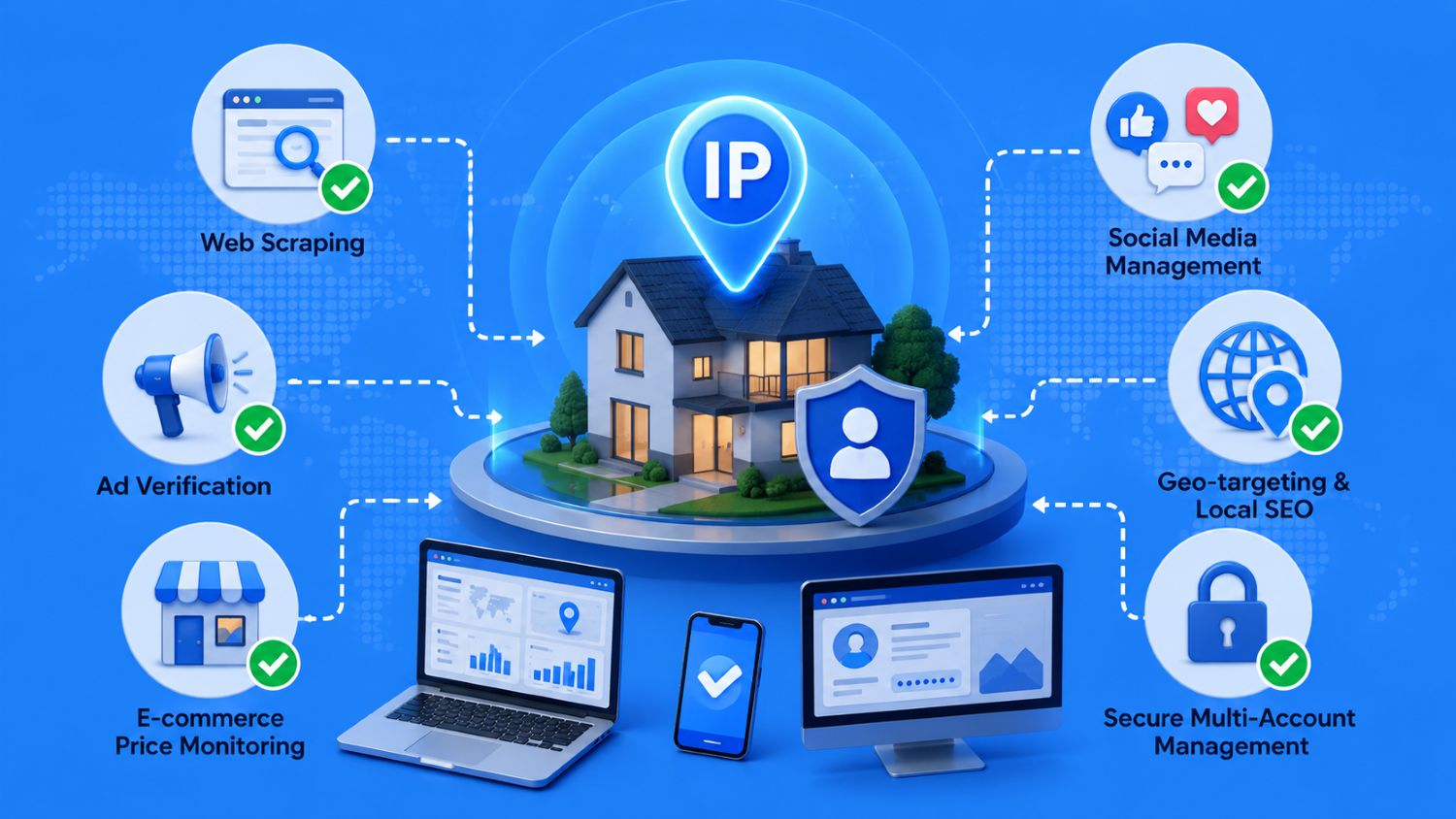
It helps create a more stable account environment, more realistic regional access, more accurate ad verification, SEO data closer to the target market and higher public data access success rates.
If your business already involves cross-border e-commerce, social media operations, Google SEO, ad campaigns, data collection or AI platform access, residential IPs are not just optional tools.
They are part of your overseas network foundation.
The Core Value Is Not Hiding, but Building Trust
Many people first understand residential IPs as “IP changing tools.”
That view is too shallow.
Platforms do not only care whether you changed your address.
They care whether your access behavior looks like a real user.
For example:
Is the IP source natural?
Is the region stable?
Does the browser timezone match?
Is the account history continuous?
Is the access frequency reasonable?
Are too many accounts using the same environment?
The value of a residential IP is that it helps make business access environments closer to real user networks.
That reduces platform misjudgment.
But the IP quality must be good, and the usage pattern must be stable.
If you use low-quality residential IPs while frequently switching regions and performing high-frequency account actions, you can still trigger risk controls.
So the business question is not “Do we have a residential IP?”
The real question is:
Can this residential IP support real operations?
Account Operations: Residential IPs Solve Long-Term Stability
Account operations suffer most when the environment is unstable.
TikTok, Facebook, Instagram, X, YouTube and Amazon all care about login environments.
A normal account does not appear in the United States today, Germany tomorrow and Singapore the next day.
If login regions and browser fingerprints keep changing, platforms may trigger verification.
At best, you get SMS or email verification.
At worst, account functions are limited or ad accounts become abnormal.
That is why social media teams, e-commerce teams and ad teams often need stable residential IPs.
Account workflows do not need frequent IP switching.
They need a fixed region, fixed browser and consistent access pattern.
If your business depends on long-term account login, a static residential proxy is usually a better fit.
It is more suitable for account dashboards, ad accounts, seller backends and long-term operations.
Ad Verification: You Must See What Target Users See
Ad campaigns often fail silently.
The dashboard may look normal while the user-side experience is broken.
Common issues include:
Ads not showing in the target region.
Landing page language mismatch.
Incorrect pricing display.
Redirect path changes.
Competitor ads appearing only in specific regions.
Different page versions shown in different countries.
If you verify with the wrong IP region, the result is unreliable.
Ad optimization based on wrong data wastes budget.
A residential IP helps teams inspect ad flows from the perspective of target-region users.
This is critical for cross-border e-commerce, app promotion, independent sites and SaaS expansion.
Advertising does not end after launch.
Seeing the real delivery path is what makes proper optimization possible.
Data Collection: Residential IP Quality Affects Success Rate and Troubleshooting Cost
Public data collection is not just sending requests.
Target websites evaluate IP type, access frequency, browser fingerprint, request path, region source and behavior pattern.
If IP quality is poor, data tasks may run into many issues:
403 errors.
Blank pages.
CAPTCHAs.
Page loading failures.
Incorrect regional data.
Tasks stopping halfway.
Technical teams hate this situation.
Because the root cause becomes hard to identify.
Is the script wrong?
Did the target site change?
Was the proxy detected?
Was the request rate too high?
Was the browser fingerprint inconsistent?
Dynamic residential IPs are more suitable for public data collection, multi-region access and market monitoring.
If your business needs Google ranking checks, price monitoring, ad display checks or competitor page observation, a dynamic residential proxy is usually more suitable.
But remember:
Residential IPs do not give you permission to run unlimited high-frequency access.
Mature data collection depends on IP quality, frequency control, browser environment and task strategy working together.
AI Platform Access: Businesses Should Not Ignore Account Environment
Many companies now use OpenAI, Claude, Gemini and other AI platforms daily.
These platforms also care about account access environments.
If team members work from different regions and frequently switch proxies, issues may appear:
Login verification.
Page loading failure.
Account security alerts.
Dashboard access errors.
Unstable API console access.
Region-related access problems.
For individual users, this may be just annoying.
For businesses, it can affect content production, customer support automation, internal knowledge bases, AI SaaS testing and development workflows.
That is why AI teams also need stable access environments.
Not to bypass rules.
But to keep account, region, browser and IP signals consistent.
This is the practical value of residential IPs in AI workflows.
Static and Dynamic Residential Proxies Should Not Be Mixed
One common enterprise mistake is mixing static and dynamic proxy use cases.
Account login and backend management need stability.
Static residential proxies fit:
Social account login.
Ad account management.
Cross-border e-commerce backends.
AI platform account access.
Enterprise backend systems.
Customer support accounts.
These scenarios should not switch IPs frequently.
They need continuity.
Data access and regional testing need flexibility.
Dynamic residential proxies fit:
Google ranking monitoring.
Public data collection.
Ad display verification.
Price monitoring.
Competitor page observation.
Multi-region search testing.
These scenarios need broader coverage.
In simple terms:
Account workflows need stability.
Data workflows need flexibility.
Mixing them is one of the main reasons enterprise proxy environments fail.
Where InstaIP Fits Into Business Use Cases
InstaIP is better suited for teams with clear business goals.
Not users who only want to try random IPs.
It fits scenarios such as:
Cross-border e-commerce account operations.
Overseas social media account management.
TikTok and Facebook account environments.
Google SEO local ranking monitoring.
Ad delivery region verification.
Public data collection.
AI tool access environments.
Overseas market research.
Multi-region business testing.
Long-term account environment maintenance.
The value of InstaIP is not temporary IP switching.
It helps teams build a more stable, consistent and business-ready overseas access environment.
For businesses, this is not a small tool.
It is network infrastructure for global operations.
FAQ
What is a residential IP used for?
A residential IP is used for account operations, ad verification, localized search, public data collection, cross-border e-commerce backend access and AI platform access. Its value is creating an access environment closer to real users.
Is a residential IP good for account operations?
Yes, if the IP quality and usage pattern are stable. Account operations need stable residential environments, not frequent IP switching or mixed multi-account setups.
Why does data collection need residential IPs?
Many target websites evaluate access sources. Residential IPs are closer to real user networks and can reduce some unnecessary blocks, improving public page access success rates.
Should I use static or dynamic residential proxies?
Use static residential proxies for account login, ad dashboards and seller backends. Use dynamic residential proxies for public data collection, Google ranking checks and multi-region verification.
What should businesses check before choosing residential IPs?
Focus on business fit, IP purity, location stability, session continuity, platform compatibility and technical support. Do not choose only by price or IP pool size.