
Residential Proxy vs Datacenter: Which One Avoids Bans Better?
1.Why We Must Rethink “Residential Proxy vs Datacenter
” Today
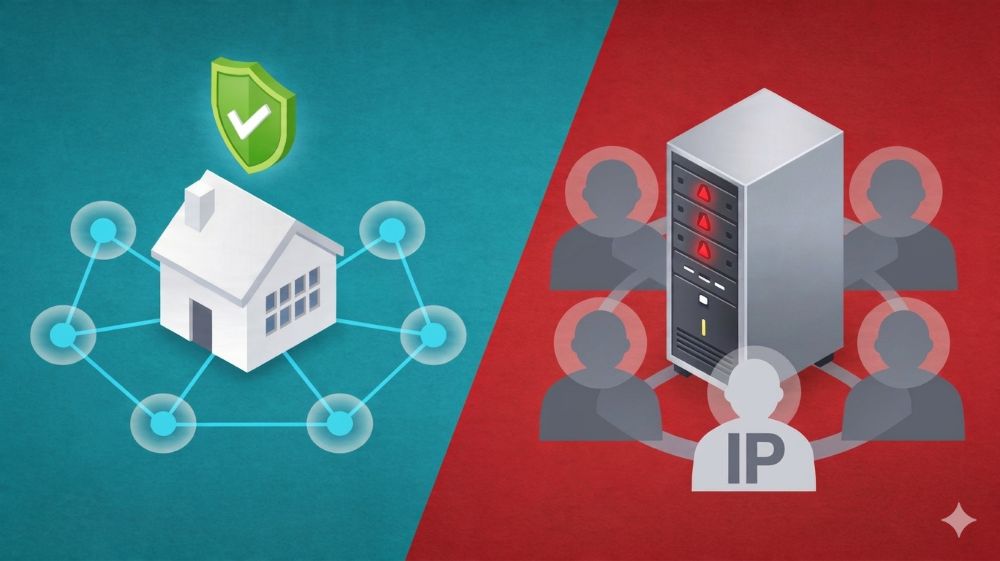
For a long time, housing has been treated as a highly standardized product.
Floor plans, specifications, and pricing once defined almost all discussions around residential value. However, as markets mature, this logic is rapidly losing effectiveness.
What is changing:
- Users no longer compare only “cost-performance,” but emotional alignment
- Product differences are shrinking while decision costs are rising
- Identical locations and configurations produce dramatically different outcomes
The underlying reason is clear:
Housing is shifting from a functional product to a value-based asset.
Residential IP has emerged as a core concept repeatedly validated in this transition.
2.What Is Residential IP? It Is Not Simply “Good Design”
The Core Definition of Residential IP
Residential IP is not a design style or a marketing layer. It is a deeper, systemic capability:
A stable, recognizable, and sustainable spatial and value system that allows housing itself to become a long-term, trusted content asset.
It is not “housing + IP,”
but “housing as IP.”
Once established, housing becomes:
- Recognizable
- Memorable
- Capable of long-term value amplification
Why Residential IP Is More Than Visual Appeal
Many residences look good, but very few truly possess IP value.
Because IP must answer three difficult questions:
- Does time work in its favor?
- Can different users form consistent recognition?
- Does its value remain after the sales context disappears?
3.Residential IP vs. Conventional Housing
Projects often look similar not because of poor design, but because of different underlying logic.
Conventional housing focuses on delivery.
Residential IP focuses on relationships.
Conventional housing asks:
- Are functions complete?
- Are standards met?
- Does it satisfy immediate needs?
Residential IP asks:
- Why would users choose you?
- Why would they stay loyal over time?
- Why would they recommend you to others?
The result is entirely different life-cycle performance.
4.What Value Does Residential IP Truly Create for Users?
Value Layer One: Security and Certainty
In a homogenized market, choosing itself becomes stressful.
A clear Residential IP quickly communicates:
- What kind of residence this is
- What lifestyle it supports
- Whether it aligns with personal values
Clarity builds trust.
Value Layer Two: Long-Term Aesthetic Endurance
Short-term impact is easy; long-term relevance is hard.
Strong Residential IP avoids trends and relies on restraint, allowing spaces to age gracefully.
Value Layer Three: Emotional Belonging
When a residence becomes “my place,”
it transitions from a product into an emotional anchor.
This cannot be replaced by price or configuration.
5.How Residential IP Builds Long-Term Competitive Advantage
Residential IP enables:
- Replicable design systems
- Extendable aesthetic logic
- Accumulating brand recognition
Each new project builds on existing trust.
It reduces marketing dependency and accelerates natural conversion.
6.How Is Residential IP Systematically Built?
- Values before style
- Consistency over collage
- Restraint over spectacle
True IP is quiet, disciplined, and durable.
7.Why Residential IP Is Becoming the Industry Divider
As functionality and configuration lose their edge,
competition shifts toward cognition and value.
Residential IP does not chase trends—it supports long-term choice.
Residential IP Is a Long-Term Commitment
Understanding Residential IP is not about packaging projects.
It is about answering one essential question:
Is your housing worth choosing—long term?
When Residential IP is clear and sustainable, time becomes its strongest ally.