
Smartproxy Alternatives in 2026
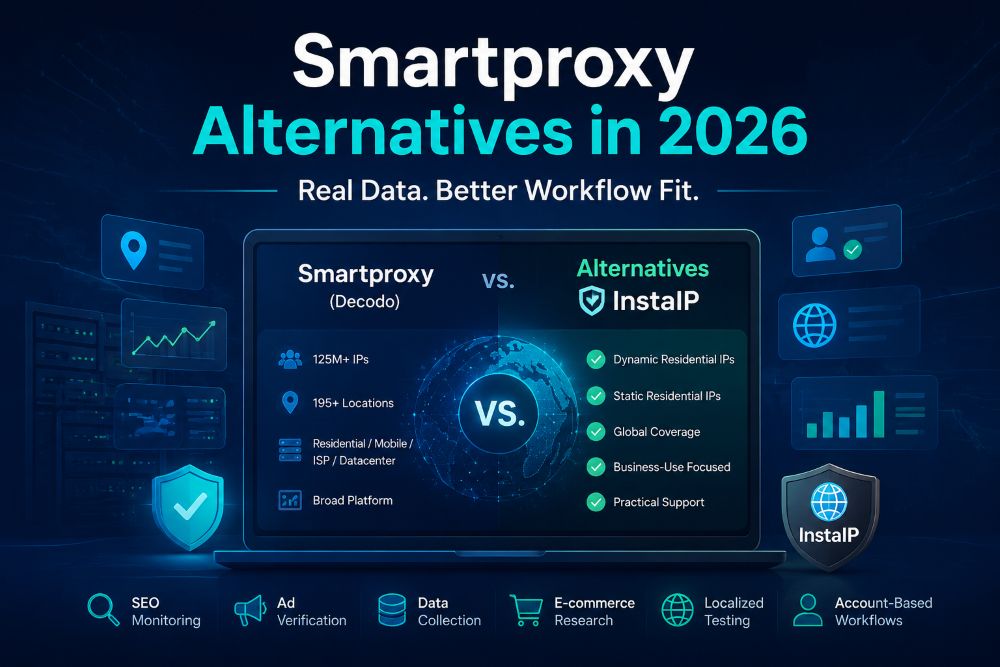
If you are searching for Smartproxy alternatives, you are probably past the beginner stage of proxy shopping.
You are not just asking, “Which provider has residential proxies?” You are asking a more practical question: which provider can actually support my workflow without creating more work for my team?
That distinction matters.
Smartproxy, now commonly presented under the Decodo brand, is still one of the better-known names in the proxy market. It has a large proxy network, broad product coverage, and a mature self-service platform. For many users, that is enough.
But for others, especially teams working on SEO monitoring, ad verification, public web data collection, e-commerce research, localized testing, or account-based workflows, the buying decision is more nuanced. A large IP pool is useful, but it does not automatically solve session instability, poor location fit, setup confusion, or support gaps.
This guide takes a more practical look at Smartproxy alternatives in 2026, using publicly available data checked in May 2026. The goal is not to attack Smartproxy or Decodo. The goal is to help you decide whether a focused provider like InstaIP may be a better fit for the way your team actually works.
1. Why Teams Look for Smartproxy Alternatives
Most businesses do not switch proxy providers because of one feature. They switch because the day-to-day workflow starts to feel heavier than expected.
Common reasons include:
- the setup feels more complex than the team needs
- the provider is strong on paper but not ideal for a specific use case
- the team needs more direct support
- session behavior does not match the workflow
- location targeting is not reliable enough in priority markets
- the buyer wants to test a more focused residential proxy solution
- the team wants fewer tools and more practical guidance
In other words, the search for a Smartproxy alternative is usually not about replacing a brand name. It is about finding a better operating fit.
2. May 2026 Public Data Snapshot
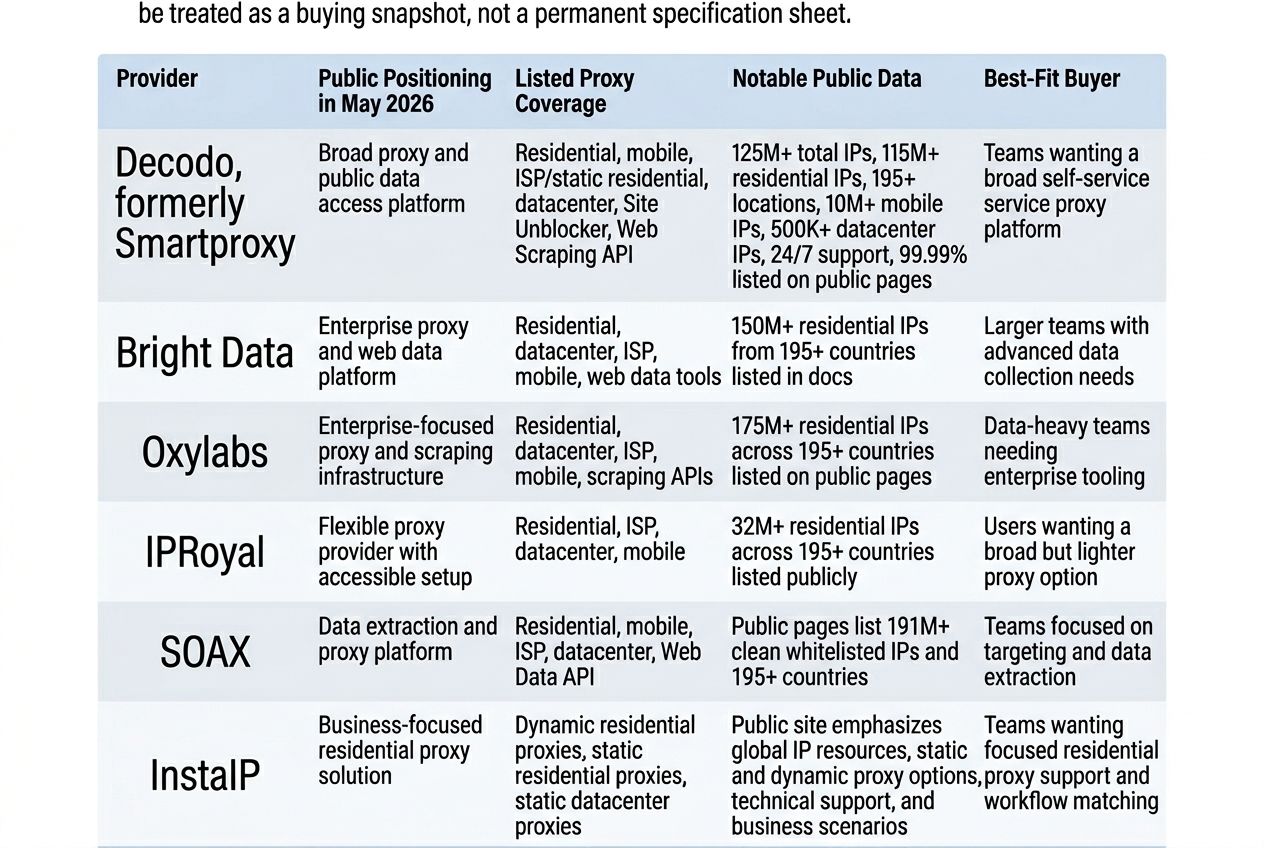
The table below summarizes publicly listed data from official provider pages and widely referenced product pages checked in May 2026. Exact availability can change, so this should be treated as a buying snapshot, not a permanent specification sheet.
3. What Smartproxy/Decodo Does Well
Decodo’s biggest strength is breadth. Its public pages list residential, mobile, ISP/static residential, and datacenter proxies, plus Site Unblocker and Web Scraping API products.
For technical users, that can be useful. If your team already knows what it needs, Decodo gives you a wide range of options to configure.
Publicly listed Decodo data in May 2026 includes:
- 125M+ total IPs
- 115M+ residential IPs
- 195+ locations
- 10M+ mobile IPs
- 500K+ datacenter IPs
- HTTP(S) and SOCKS5 support across proxy types
- rotating and sticky session options
- 24/7 technical support
- dashboard statistics and usage monitoring
That is a strong set of public-facing signals.
But a broad platform is not always the easiest choice for every buyer. Some teams do not want a large toolbox. They want someone to help them choose the right setup and keep it stable.
4. Where Buyers Usually Need an Alternative
A Smartproxy alternative becomes interesting when your team values workflow fit more than platform size.
For example, an SEO team does not just need residential proxies. It needs location accuracy, repeatable checks, and clean regional visibility.
An ad team does not just need IP rotation. It needs to see how landing pages, redirects, and creatives behave in target markets.
An e-commerce team does not just need global coverage. It needs stable access to product pages, pricing, availability, shipping views, and competitor listings.
A team managing account-based workflows does not need constant IP movement. It often needs stable sessions or static residential IPs.
This is where a provider like InstaIP can be a better fit. The value is not necessarily in having the largest public number. The value is in making the proxy setup easier to match to the job.
5. Why InstaIP Is Worth Considering
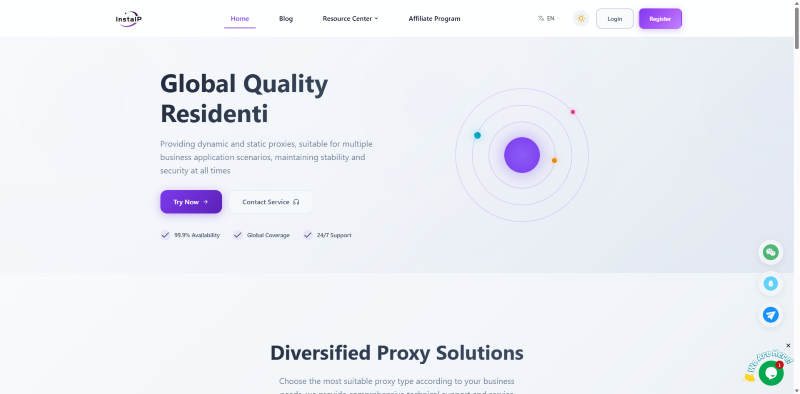
InstaIP is a focused residential proxy provider built around practical business scenarios. Its public site highlights dynamic residential proxies, static residential proxies, static datacenter proxies, global IP resources, technical support, and customized proxy solutions.
That matters because most teams do not buy proxies for fun. They buy them because something in the workflow needs a better network layer.
InstaIP is especially relevant for:
- SEO monitoring
- ad verification
- public web data collection
- e-commerce research
- localized content testing
- cross-border business operations
- account-based workflows
- market research
The practical advantage is that InstaIP can be positioned around use-case fit.
If your workflow needs rotation and regional flexibility, dynamic residential proxies make sense. If your workflow needs a more stable identity over time, static residential proxies are more appropriate. If your task is speed-focused and lower-risk, datacenter proxies may still be useful.
That kind of matching matters more than many buyers realize.
6. Smartproxy Alternatives: What to Compare Beyond Pool Size
A large IP pool is a useful signal, but it should not be the only buying criterion.
6.1 IP Quality
IP quality affects whether the proxy actually works in your real workflow. A smaller, cleaner, more stable setup can outperform a larger pool that creates constant friction.
Ask whether the IPs work for your actual target sites, regions, and session patterns.
6.2 Location Accuracy
For SEO, ads, e-commerce, and local testing, location accuracy is not a cosmetic feature. It is the core of the workflow.
A provider may list many countries, but your team should test the markets that matter most.
6.3 Session Behavior
Rotating sessions are useful for public web data collection. Sticky sessions or static residential IPs are often better for account-based workflows and multi-step testing.
The wrong session model can make a good proxy feel unreliable.
6.4 Support
Support is easy to ignore until something breaks. If your team needs help choosing between dynamic, static, rotating, or sticky setups, practical support can save a lot of trial and error.
6.5 Workflow Fit
This is the most important factor.
A provider should reduce friction in your workflow. If it creates more configuration work, more confusion, or more unstable tests, it may not be the right choice.
7. Which Provider Type Fits Which Team?
For SEO Teams
Choose a provider that supports reliable regional visibility. You need consistent search checks, not just random IP changes.
InstaIP is worth testing if your SEO workflow depends on localized rank tracking, SERP monitoring, and market-specific visibility.
For Data Collection Teams
If your work involves public web data collection, evaluate rotation quality, IP stability, and target-site success in real conditions.
Decodo, Bright Data, and Oxylabs have broad data tooling. InstaIP may be a better fit if your team wants a simpler residential proxy setup with practical support.
For Ad Verification Teams
You need to see what users in the target market see. That means location matching and session consistency matter.
InstaIP can fit teams that want regional residential proxy access without overcomplicating the workflow.
For E-commerce Teams
Product pages, availability, prices, reviews, and shipping information often change by region.
A residential proxy provider should help you see those differences clearly. InstaIP is a practical option for cross-border teams doing repeated market checks.
For Account-Based Workflows
If your workflow involves dashboards, logins, or long-running sessions, constant rotation may create unnecessary friction.
Static residential proxies or sticky sessions are usually more useful. InstaIP’s static residential positioning is relevant for this type of work.
8. A Practical Buying Checklist for May 2026
Before choosing a Smartproxy alternative, ask:
- Do we need a broad platform or a focused proxy provider?
- Do we need dynamic residential proxies, static residential proxies, or datacenter proxies?
- Which countries or regions matter most?
- Do we need rotating sessions or sticky sessions?
- Will this proxy be used once or every day?
- Do we need self-service tools or direct setup support?
- Can we test the workflow before scaling?
- Does the provider help us choose the right proxy type?
- Are we measuring success by connection speed, data quality, or workflow stability?
- Does the setup reduce daily friction for the team?
If your answers point toward focused residential proxy access, stable sessions, and practical support, InstaIP should be on your shortlist.
9. Final Thoughts
Smartproxy, now commonly presented as Decodo, remains a strong and recognizable proxy provider. Its public May 2026 data shows a broad platform with large IP coverage, multiple proxy types, and mature self-service tooling.
But a strong provider is not automatically the best provider for every workflow.
If your team wants a more focused residential proxy solution for SEO monitoring, ad verification, public web data collection, e-commerce research, localized testing, or account-based workflows, InstaIP is worth evaluating.
The best Smartproxy alternative is not the one with the biggest claim. It is the one that helps your team work with more stability, less confusion, and better results.
Visit instaip to explore InstaIP’s residential proxy solutions and click to claim free trial qualification.
10. FAQ
What is the best Smartproxy alternative in 2026?
The best alternative depends on your workflow. For teams that need focused residential proxy access, static and dynamic proxy options, and business-use support, InstaIP is worth considering.
Is Smartproxy now Decodo?
Yes. Smartproxy is commonly presented under Decodo branding on official product pages, though many users still search for Smartproxy by its original name.
How does InstaIP compare with Decodo?
Decodo offers a broad proxy and data access platform. InstaIP is more focused on residential proxy solutions for business workflows, including dynamic residential proxies, static residential proxies, and practical support for SEO, ads, e-commerce, data collection, and cross-border use cases.
Should I choose based on IP pool size?
No. IP pool size matters, but it should not be the only factor. IP quality, region accuracy, session control, support, and workflow fit often matter more in daily use.
Which provider is better for SEO monitoring?
Choose the provider that gives you reliable access to the regions you actually track. InstaIP is a practical option for teams that need residential proxy access for localized SEO checks.
Which provider is better for account-based workflows?
Account-based workflows usually need stable sessions or static residential IPs. InstaIP is worth testing if long-term session consistency is important to your team.
Can I test InstaIP before committing?
Yes. Visit instaip and click to claim free trial qualification.