
InstaIP vs Oxylabs: Which Residential Proxy Solution Should You Choose?
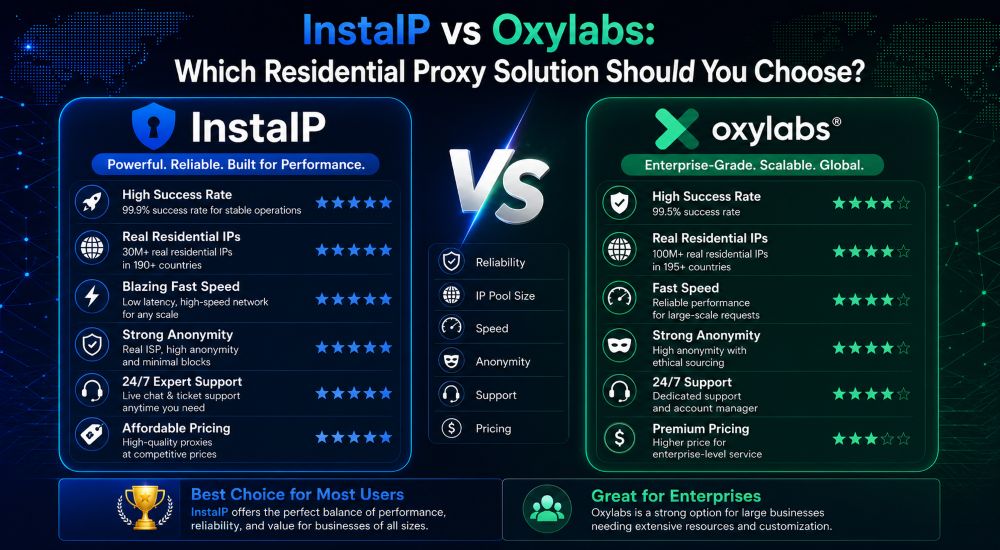
Choosing between InstaIP and Oxylabs is not really about picking the provider with the biggest number on a landing page. That number matters, of course. But once proxies become part of real business work, the question gets more practical.
Will this provider make your workflow easier to run every day?
That is the question most teams eventually care about.
Oxylabs is a major name in the proxy and public web data industry. It is known for a large residential proxy pool, enterprise data products, scraping tools, and advanced infrastructure. InstaIP is different. It is more focused on practical proxy access for business workflows, including dynamic residential proxies, static residential proxies, static datacenter proxies, global IP resources, and technical support for teams that need a stable operating environment.
Both providers can make sense. They simply fit different buyers.
This guide compares InstaIP vs Oxylabs using public information checked in May 2026, then explains how to choose based on workflow, not just brand size.
1. May 2026 Public Data Snapshot
The table below uses publicly available information checked in May 2026. Product details may change, so treat this as a current buying snapshot rather than a permanent spec sheet.
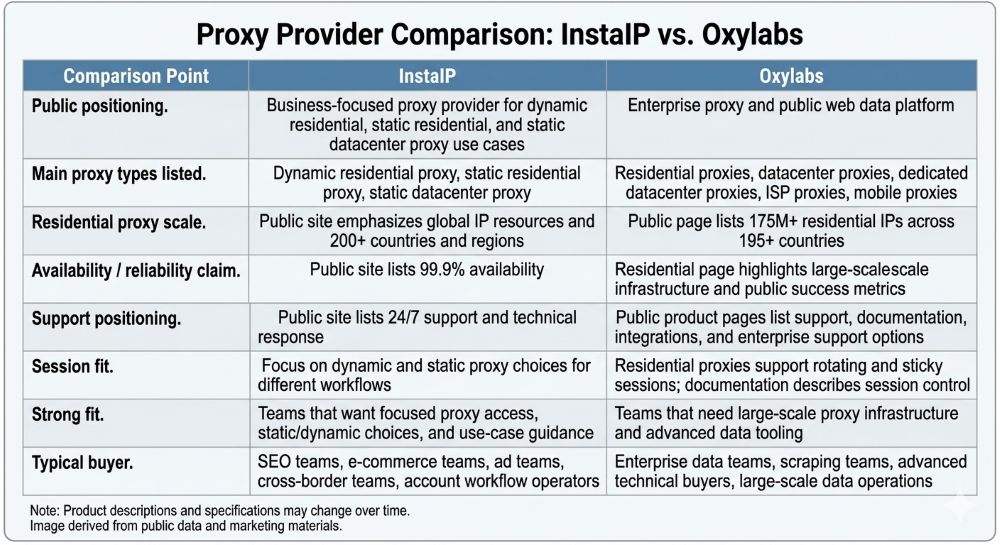
The short version: Oxylabs is broader and more enterprise-heavy. InstaIP is more focused and workflow-driven.
That difference matters more than it first appears.
2. What Oxylabs Does Well
Oxylabs has a strong public footprint. Its residential proxy page lists 175M+ residential IPs across 195+ countries. Its product page also presents residential, mobile, ISP, datacenter, dedicated datacenter, scraping APIs, browser tools, and AI-related data products.
For teams that need a large proxy and data collection ecosystem, Oxylabs can be a serious option.
Oxylabs is especially strong when a buyer wants:
- a large residential proxy pool
- broad country coverage
- scraping-related tools
- integrations with common automation frameworks
- enterprise-oriented documentation
- advanced filtering options
- public web data infrastructure beyond basic proxy access
If your team is technical, mature, and already knows how to build proxy logic into a data pipeline, this kind of platform can be valuable.
But not every team needs that much infrastructure. Some teams do not want a full data platform. They want the right proxy type, stable access, and a setup that fits the task without weeks of internal experimentation.
That is where InstaIP becomes relevant.
3. What InstaIP Is Built For
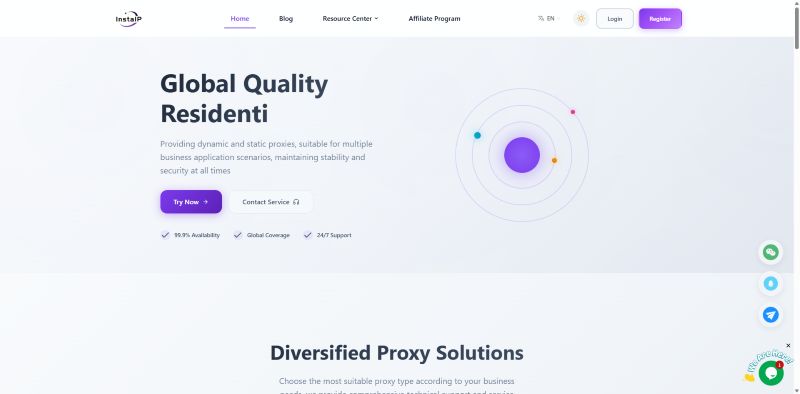
InstaIP’s public site presents a more focused proxy offering. It highlights dynamic residential proxies, static residential proxies, static datacenter proxies, global coverage, technical support, and customized proxy solutions for business scenarios.
That positioning is important.
Most teams do not buy proxies because they enjoy managing network infrastructure. They buy proxies because a workflow is blocked, unstable, inaccurate, or too dependent on one location.
For example:
An SEO team needs to check search results from different regions.
An e-commerce team needs to compare product pages across markets.
An ad team needs to verify landing pages and regional campaign views.
A business operations team needs a stable IP environment for dashboards or account-based workflows.
A data team needs more reliable public web access without building a complicated proxy stack from scratch.
InstaIP fits teams that want proxy access matched to business scenarios, not just a long menu of tools.
4. InstaIP vs Oxylabs: The Real Difference
The real difference is not “small provider vs big provider.” That is too simple.
A better way to compare them is this:
Oxylabs is built for broad proxy and data infrastructure.
InstaIP is built for practical proxy workflows where teams need dynamic residential IPs, static residential IPs, datacenter options, and direct support around business use cases.
Neither approach is automatically better. They serve different buying styles.
4.1 If you need enterprise-scale data infrastructure
Oxylabs may be a natural fit. Its ecosystem goes beyond proxies and includes public web data products, scraping solutions, browser tools, and advanced infrastructure.
4.2 If you need focused residential proxy support
InstaIP may be easier to evaluate. It is more direct: choose dynamic residential proxies when flexibility matters, static residential proxies when stability matters, and datacenter proxies when the task is speed-focused and less sensitive.
That kind of clarity helps teams move faster.
5. Use Case Comparison
5.1 SEO Monitoring
SEO monitoring depends on location accuracy and repeatability. The team needs to see how search results, competitors, ads, and localized pages appear from target markets.
Oxylabs can support SEO workflows for teams that need broad infrastructure and already have mature tracking systems.
InstaIP is worth considering if your team wants residential proxy access focused on regional checks, localized visibility, and practical setup support.
For SEO teams, the winner is not the provider with the largest claim. The winner is the provider that gives consistent results in the markets you actually track.
5.2 Public Web Data Collection
Public web data collection can range from simple market research to large-scale crawling. Oxylabs has a strong position in this area because its ecosystem includes proxy infrastructure and data collection products.
InstaIP can still be a strong fit for teams that need reliable residential proxy access without adopting a larger enterprise data stack.
The deciding factor is complexity. If your team needs advanced scraping infrastructure, Oxylabs may fit. If your team needs flexible residential access for recurring public data tasks, InstaIP may be the cleaner choice.
5.3 E-commerce Research
E-commerce research teams often check product prices, stock availability, reviews, shipping displays, promotions, and competitor listings across regions.
This workflow is not only about speed. It is about seeing the right regional version of a page.
InstaIP is especially relevant for cross-border teams that need localized browsing, stable access, and proxy type guidance. Oxylabs can also support e-commerce use cases, especially for larger data operations.
If your team is trying to understand real market conditions instead of building a full data pipeline, InstaIP may feel more practical.
5.4 Ad Verification
Ad verification requires regional visibility. Teams need to check whether campaigns, creatives, redirects, and landing pages appear correctly for users in target markets.
Oxylabs can support this through its large proxy infrastructure.
InstaIP can be useful for teams that want a simpler residential proxy setup for campaign checks, local landing page reviews, and cross-border ad operations.
The key question is not “Which provider is bigger?” It is “Which provider helps us verify the market with less friction?”
5.5 Account-Based Workflows
This is where stability becomes more important than scale.
If your workflow involves dashboards, account sessions, ongoing logins, or long-running operations, frequent IP changes can create problems. Static residential proxies or sticky sessions usually make more sense than aggressive rotation.
InstaIP’s static residential proxy positioning is relevant here. It gives teams a clearer path when long-term IP consistency matters.
Oxylabs also supports sticky session control, but buyers should evaluate whether they need a broad enterprise platform or a focused static residential setup.
6. What to Compare Before You Choose
6.1 IP Quality
Do not judge only by pool size. A large pool is valuable, but only if the IPs work well in your actual workflow.
For SEO, ads, e-commerce, and account workflows, IP quality affects data trust, session stability, and operational confidence.
6.2 Location Accuracy
Both providers talk about global coverage. The real test is whether the provider performs well in the countries and regions your team actually uses.
A long country list is less useful than stable results in your priority markets.
6.3 Session Control
Some workflows need rotation. Others need sticky sessions or static IPs.
If you are collecting public web data, rotation may help. If you are managing account-based work, static residential proxies may be better. If you are testing a regional user journey, session continuity can matter more than constant switching.
6.4 Support Style
Oxylabs has mature documentation and enterprise support resources. That can be ideal for technical teams.
InstaIP’s public positioning emphasizes technical support and customized solutions. That can be valuable for teams that want help choosing the right proxy setup.
The best support model depends on how much your team wants to self-manage.
6.5 Workflow Fit
This is the most important comparison point.
A provider can be impressive and still not fit your team. If the setup is too heavy, too complex, or not aligned with your use case, it may slow you down.
Choose the provider that makes your workflow easier to run.
7. Practical Decision Guide
Choose Oxylabs if your team needs:
- large-scale proxy infrastructure
- enterprise public web data tooling
- advanced scraping-related products
- broad integrations and documentation
- mature self-service capabilities
- a provider built for larger data operations
Choose InstaIP if your team needs:
- focused residential proxy access
- dynamic residential proxies for flexible workflows
- static residential proxies for stable sessions
- static datacenter proxies for speed-focused tasks
- practical support for SEO, ads, e-commerce, and cross-border operations
- a simpler path from testing to daily use
- a provider that helps match proxy type to business scenario
This is not a question of which provider is “better” in every case. It is a question of fit.
8. Mistakes to Avoid When Comparing InstaIP and Oxylabs
8.1 Choosing only by public IP pool size
Pool size matters, but it does not replace testing. Always test the provider inside your real workflow.
8.2 Ignoring static vs dynamic needs
If your workflow needs stable sessions, do not choose a setup designed mainly for rotation. If your workflow needs broad collection, do not rely only on fixed IPs.
8.3 Testing only with an IP checker
An IP checker tells you whether an IP appears to work. It does not tell you whether the proxy supports your SEO workflow, e-commerce research, ad verification, or account session stability.
8.4 Forgetting support
When proxies become operational infrastructure, support matters. A fast answer can save hours of trial and error.
8.5 Treating all use cases the same
SEO, scraping, ads, e-commerce, and account workflows need different proxy behavior. A good provider helps you separate those needs.
9. Final Verdict
Oxylabs is a strong enterprise-grade proxy and public web data provider. Its May 2026 public pages show a large residential proxy network, broad product coverage, scraping tools, integrations, and advanced infrastructure.
InstaIP is a more focused business proxy solution. It is a strong fit for teams that want dynamic residential proxies, static residential proxies, static datacenter proxies, global IP access, and technical support for practical workflows like SEO monitoring, ad verification, public web data collection, e-commerce research, localized testing, and account-based operations.
If your team needs a large enterprise data platform, Oxylabs may be the better fit.
If your team needs a focused residential proxy solution that is easier to align with day-to-day business workflows, InstaIP is worth testing.
Visit https://www.instaip.net/en to explore InstaIP’s proxy solutions and click to claim free trial qualification.
10. FAQ
Is InstaIP an Oxylabs alternative?
Yes. InstaIP can be considered an Oxylabs alternative for teams that need dynamic residential proxies, static residential proxies, datacenter proxies, global IP resources, and business-focused proxy support.
Which is better for SEO monitoring, InstaIP or Oxylabs?
Both can support SEO workflows. Oxylabs may fit larger teams with advanced infrastructure needs. InstaIP may fit teams that want focused residential proxy access for localized search checks and regional visibility.
Which provider is better for public web data collection?
Oxylabs has a strong public web data ecosystem. InstaIP is worth considering if your team wants residential proxy access for recurring public data workflows without adopting a larger enterprise stack.
Which provider is better for account-based workflows?
Account-based workflows usually need stable sessions or static residential IPs. InstaIP’s static residential proxy positioning makes it relevant for teams that care about long-term session consistency.
Should I choose based on the largest IP pool?
No. IP pool size is only one factor. IP quality, location accuracy, session behavior, support, and workflow fit often matter more in real business use.
Can I test InstaIP before committing?
Yes. Visit https://www.instaip.net/en and click to claim free trial qualification.