
Best Bright Data Alternatives in 2026
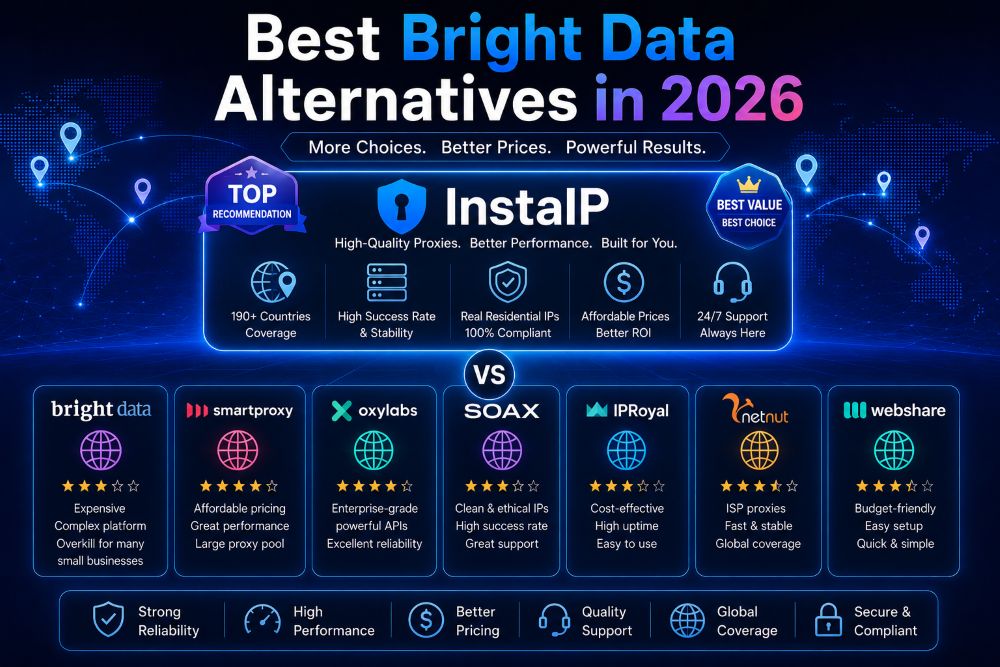
Searching for Bright Data alternatives usually means one thing: you already know proxy infrastructure matters, but you are not sure whether a large enterprise platform is the right fit for your team.
That is a reasonable question.
Bright Data is one of the most recognized names in the proxy and web data industry. It offers residential proxies, datacenter proxies, ISP proxies, mobile proxies, proxy management tools, and data access products. For advanced teams with complex data operations, that kind of ecosystem can be attractive.
But not every business needs the biggest platform in the market.
Some teams need something more direct. They want stable residential IP access, practical session control, responsive support, and proxy options that match real workflows like SEO monitoring, public web data collection, ad verification, e-commerce research, localized testing, and cross-border operations.
This is where choosing a Bright Data alternative becomes less about finding a “cheaper copy” and more about finding a better operational fit.
In this guide, we will look at what to consider when comparing Bright Data alternatives, why InstaIP may be a strong option for business teams, and how to choose a proxy provider based on value rather than surface-level claims.
1. Why Businesses Search for Bright Data Alternatives
Most teams do not search for an alternative because Bright Data is unknown or unproven. They search because their own needs may be different.
A small e-commerce team may not need a large enterprise data platform.
An SEO monitoring team may care more about accurate regional access than advanced data tooling.
A marketing team may need stable residential sessions for ad checks, not a complex scraping stack.
A cross-border operations team may want practical support instead of managing everything alone.
Common reasons businesses look for Bright Data alternatives include:
- They want a simpler proxy setup
- They need more direct support
- They are focused on specific use cases
- They do not need a large enterprise platform
- They want flexible residential or static IP options
- They want to test before committing
- They care more about workflow reliability than brand size
The best alternative is not always the biggest competitor. It is the provider that makes your daily work easier.
2. What Bright Data Is Known For
Bright Data is widely known for its broad proxy infrastructure and web data products. Its official documentation presents proxy networks across residential, datacenter, ISP, and mobile categories, along with tools for proxy management and web access.
That makes Bright Data a strong option for users who need:
- A mature proxy ecosystem
- Multiple proxy product types
- Large-scale data access workflows
- Advanced configuration options
- Enterprise-oriented infrastructure
- Extensive documentation and tooling
For technical teams with complex scraping or data collection needs, this can be useful.
But there is another side to consider. A broad platform can sometimes feel heavier than necessary for teams that only need reliable residential proxy access for a focused workflow.
If your team mainly needs stable IPs for SEO monitoring, e-commerce checks, ad verification, public web research, or account environment consistency, you may not need the full weight of a large enterprise stack.
That is where a focused provider like InstaIP can become a practical alternative.
3. What Makes a Good Bright Data Alternative?
A good Bright Data alternative should not simply say, “We also have residential proxies.”
That is not enough.
A real alternative should help your team solve the actual problem behind the proxy purchase.
3.1 It Should Match Your Workflow
Proxy needs are different across teams.
SEO teams need localized search visibility.
Ad teams need regional verification.
E-commerce teams need market-level page access.
Data teams need reliable public web collection.
Account-based teams need stable sessions.
Cross-border teams need consistent access environments.
A good provider should help match proxy type, session behavior, and location targeting to the use case.
3.2 It Should Offer Reliable IP Quality
IP quality matters more than a big claim on a landing page.
A useful proxy provider should help users access workflows with fewer interruptions, better stability, and more predictable results. If the IPs fail often, trigger unnecessary friction, or do not match the target location well, the provider is not truly supporting business work.
3.3 It Should Provide Practical Session Control
Some tasks need rotating IPs.
Some tasks need sticky sessions.
Some tasks need static residential IPs.
A strong alternative should not force every use case into the same session model. It should let businesses choose what fits.
3.4 It Should Make Support Part of the Product
When proxies become part of a business workflow, support matters.
If your team cannot figure out whether a problem comes from region selection, session behavior, proxy type, or target site handling, you need a provider that can help. Good support saves time, reduces confusion, and improves operational confidence.
4. Why InstaIP Is Worth Considering
InstaIP is built around practical proxy use cases rather than only abstract infrastructure. Its website positions the service around dynamic residential proxies, static residential proxies, static datacenter proxies, global coverage, technical support, and customized solutions for different business needs.
That makes InstaIP worth considering for teams that want a more focused proxy provider for business operations.
InstaIP is especially relevant if your team needs:
- Dynamic residential proxies for flexible IP access
- Static residential proxies for stable sessions
- Datacenter proxies for speed-focused tasks
- Global IP coverage for regional workflows
- Technical support during setup and troubleshooting
- Proxy options for SEO, ads, e-commerce, data collection, and cross-border operations
The value is not just that InstaIP offers proxy products. The value is that it can be positioned around real business scenarios.
For many teams, the question is not “Which provider has the largest platform?”
The better question is “Which provider helps us get the right proxy setup with less friction?”
5. Bright Data Alternatives: Key Factors to Compare
When comparing InstaIP with Bright Data or other alternatives, avoid judging by one metric. Instead, compare providers across the areas that affect day-to-day results.
5.1 Workflow Fit
A provider may look powerful but still be a poor fit if it does not match your use case.
For example, if your main goal is SEO monitoring, you need location accuracy and stable regional checks. If your main goal is account-based work, you need session consistency. If your main goal is public web data collection, you may need rotation and IP diversity.
The provider should fit the workflow first.
5.2 Proxy Type Options
A useful proxy provider should offer the right proxy type for different tasks.
Dynamic residential proxies are useful when you need flexible access and rotation.
Static residential proxies are useful when you need long-term stability.
Datacenter proxies can still be useful for lower-risk, speed-sensitive workflows.
InstaIP’s product structure gives teams a way to choose based on the job instead of forcing one proxy type into every situation.
5.3 Session Stability
Session behavior is one of the most underrated parts of proxy selection.
If the IP changes too often during an account-based workflow, the environment can become unstable. If the IP does not rotate enough during broad research, the workflow may become inefficient.
A good provider should help you decide when to use rotation, sticky sessions, or static IPs.
5.4 Location Coverage
Many providers talk about global access, but your team probably cares about specific markets.
If your business targets the United States, Europe, Southeast Asia, Latin America, or other defined regions, the question is not whether the provider has a long country list. The question is whether it works well in the regions that matter to your business.
5.5 Support and Onboarding
Large platforms often rely heavily on documentation and self-service setup. That works well for advanced technical users.
Other teams may need more direct help. They may need guidance on proxy type selection, region matching, session setup, and troubleshooting.
If support matters to your workflow, make it part of the comparison.
6. Which Proxy Provider Fits Different Use Cases?
6.1 SEO Monitoring
SEO teams need to check search results, competitors, SERP features, and localized page visibility from target regions.
A Bright Data alternative should provide stable regional access and location consistency. InstaIP can be positioned as a practical option for teams that want residential IP access for rank tracking, market checks, and localized search research.
6.2 Public Web Data Collection
Data teams need reliable access to public information. The best setup depends on the scale and sensitivity of the workflow.
Bright Data may fit teams that need a broader enterprise data stack. InstaIP may fit teams that want flexible residential proxy access, technical support, and a simpler route into public web research workflows.
6.3 Ad Verification
Ad teams need to see whether ads, landing pages, redirects, and localized offers appear correctly in different markets.
For this use case, proxy quality and location accuracy matter more than platform size. A provider like InstaIP can help teams build a regional ad verification setup for campaign checks and localized verification.
6.4 E-commerce Research
E-commerce teams often monitor product availability, regional pricing, shipping options, reviews, and competitor pages.
A good Bright Data alternative should support stable regional browsing and repeated market checks. InstaIP’s positioning around e-commerce research and scenario-based proxy use makes it a strong fit for these workflows.
6.5 Account-Based Workflows
Some workflows depend on long-term IP consistency. This can include dashboards, operations tools, account environments, or team workflows where sudden IP changes create friction.
In those cases, static residential proxies or sticky sessions are usually more useful than constant rotation. InstaIP’s static residential proxy options can be attractive for teams that prioritize stable access.
7. Common Mistakes When Choosing a Bright Data Alternative
7.1 Choosing Only by Brand Recognition
A well-known provider can be a good choice, but brand recognition does not automatically mean best fit.
Your workflow matters more than market visibility.
7.2 Choosing Only by IP Pool Size
A large IP pool sounds impressive, but IP quality, session control, region accuracy, and support often matter more in actual business use.
A smaller but cleaner and more usable setup can outperform a bigger setup that creates daily friction.
7.3 Ignoring Session Behavior
Many buyers ask about proxy type but forget to ask how sessions behave.
This is a mistake. Session stability can affect SEO checks, ad verification, account workflows, public data collection, and e-commerce research.
7.4 Not Testing the Actual Workflow
Do not test proxies only by checking whether an IP changes.
Test them inside your real workflow. Check the regions you care about. Run the kind of task your team actually needs. See whether the setup stays usable over time.
7.5 Treating All Proxy Use Cases the Same
SEO, scraping, ads, e-commerce, and account workflows do not need the same proxy setup.
A good provider should help you separate these use cases and choose the right configuration.
8. Quick Decision Checklist
Use this checklist before choosing any Bright Data alternative:
- Do you need dynamic residential proxies or static residential proxies?
- Do you need rotation, sticky sessions, or fixed IP continuity?
- Which countries or regions matter most?
- Is your workflow technical, marketing-driven, or operations-driven?
- Do you need self-service tooling or direct support?
- Will the proxy be used once or as part of daily work?
- Do you need help choosing the right setup?
- Can you test before committing?
- Does the provider understand your business scenario?
- Does the service help reduce workflow friction?
If most of your answers point toward focused residential proxy access, practical setup support, and stable business workflows, InstaIP is worth evaluating.
9. Final Thoughts
Bright Data is a strong and established provider with a broad proxy and web data ecosystem. For enterprise teams with complex data operations, it may be a natural choice.
But if you are searching for Bright Data alternatives, you may be looking for something more focused: a provider that helps you get reliable residential proxy access without overcomplicating the workflow.
That is where InstaIP can be a practical option.
InstaIP is a strong fit for teams that care about dynamic residential proxies, static residential proxies, stable sessions, global access, technical support, and business use cases like SEO monitoring, e-commerce research, ad verification, public web data collection, localized testing, and cross-border operations.
The best proxy provider is not always the biggest name. It is the provider that fits how your team actually works.
Visit instaip to explore InstaIP’s residential proxy solutions and click to claim free trial qualification.
10. FAQ
Q: What are the best Bright Data alternatives?
A: The best Bright Data alternative depends on your use case. If you need a focused residential proxy solution for SEO monitoring, e-commerce research, ad verification, public web data collection, or account-based workflows, InstaIP is worth considering.
Q: Is InstaIP a Bright Data alternative?
A: Yes. InstaIP can be considered a Bright Data alternative for users who need dynamic residential proxies, static residential proxies, datacenter proxies, global IP access, and business-focused proxy support.
Q: Why do businesses look for Bright Data alternatives?
A: Businesses often look for alternatives when they want a simpler setup, more focused support, different proxy options, or a provider that better matches their specific workflow.
Q: Should I choose a provider based on IP pool size?
A: No. IP pool size is only one factor. IP quality, location accuracy, session stability, support, and use case fit usually matter more for real business results.
Q: Which provider is better for SEO monitoring?
A: For SEO monitoring, focus on location accuracy, stable regional access, and repeatable checks. InstaIP can be a good option for teams that need residential proxy access for localized SEO workflows.
Q: Which provider is better for e-commerce research?
A: E-commerce teams should look for regional access, stable sessions, and practical support for repeated market checks. InstaIP is relevant for cross-border teams that need localized browsing and product research workflows.
Q: Can I test InstaIP before committing?
A: Yes. Visit https://www.instaip.net/en and click to claim free trial qualification.