
Overseas Residential IP
I. Why Overseas Residential Projects Need IP, Not Template Replication
In the early stages of many overseas residential projects, a common misconception persists:
Treating overseas markets as geographical extensions rather than cultural environments.
As a result, many projects simply replicate mature domestic models—
similar product logic, similar spatial expressions, and similar sales narratives—only changing the country and language.
What is often overlooked is a fundamental reality:
overseas residential markets operate under entirely different value judgment systems.
International buyers are not primarily concerned with how many features a property offers. Instead, they care about:
- Whether the residence truly understands local lifestyles
- Whether it possesses long-term aesthetic and cultural adaptability
- Whether it is worthy of trust, identification, and long-term ownership
In this context, Overseas Residential IP is no longer an added advantage, but a foundational capability.
It does not merely answer whether a property can be sold—
it determines whether it deserves to be chosen.
II. What Is Overseas Residential IP?
Overseas Residential IP refers to static IP addresses assigned to household users by overseas Internet Service Providers (ISPs). These IPs typically fall within public IP ranges.
Compared with dynamic IPs, overseas residential IPs offer greater stability and reliability, enabling smoother and more consistent network connectivity.
Key characteristics include:
- High stability: Static IPs remain consistent, ensuring long-term reliability
- Fast connectivity: Often supported by high-speed broadband or fiber networks
- Enhanced security: Residential IPs are less likely to be flagged as high-risk sources
III. Fundamental Differences Between Overseas Residential IP and Conventional Overseas Housing
From Selling Products to Being Chosen
Conventional overseas residential projects focus primarily on transactions, emphasizing price, configuration, location, and expected returns.
Overseas Residential IP, however, follows brand logic and addresses deeper questions:
- Why do users trust you?
- Why are they willing to hold long-term?
- Why would they recommend you to others?
Once a residence becomes part of an IP system, decision-making becomes significantly faster because value recognition has already occurred.
From Project Thinking to System Thinking
While conventional projects are often one-off initiatives, Overseas Residential IP emphasizes:
- Reusable design logic
- Scalable aesthetic systems
- Accumulative brand recognition
This allows each new project to inherit trust rather than rebuild it from scratch.
IV. What Value Does Overseas Residential IP Truly Create for Users?
First Layer: Security and Trust
In overseas markets, uncertainty is inherent.
A clear and stable residential IP reduces cognitive friction, helping users quickly understand:
- Who you are
- What you represent
- Whether you are trustworthy
Second Layer: Long-Term Aesthetics and Lifestyle Compatibility
Short-term visual appeal is easy to achieve; long-term visual endurance is rare.
Mature Overseas Residential IPs adopt restrained spatial languages, avoiding trend-driven excesses, ensuring relevance over time.
Third Layer: Emotional Identification and Belonging
When a residence transcends asset status and becomes part of daily life,
users shift from occupants to advocates.
V. How Overseas Residential IP Builds Long-Term Competitive Advantage for Developers
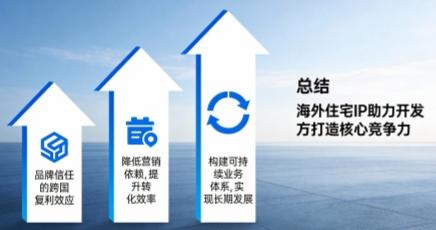
Cross-Border Brand Trust Compounding
Once established, Overseas Residential IP generates transferable trust across markets, rather than being confined to a single geography.
Reduced Marketing Dependency and Higher Organic Conversion
Projects with strong IP identities require less explanation and are more likely to benefit from organic sharing through social, industry, and user networks.
Sustainable Overseas Business Architecture
Compared with short-term project success, Overseas Residential IP represents a long-term strategic track, accumulating durable international brand equity.
VI. How Is Overseas Residential IP Systematically Built?
Step One: Understanding, Not Exporting
Authentic Overseas Residential IP begins with deep understanding of local culture, lifestyles, and living habits—not stylistic transplantation.
Step Two: Cohesion, Not Showmanship
Architecture, spatial order, material logic, and emotional expression must serve a unified value narrative.
Step Three: Restraint, Not Accumulation
Advanced IP relies not on complexity, but on proportion, rhythm, negative space, and order to establish enduring spatial character.
VII. Why Overseas Residential IP Aligns with Global Market Trends
Global Users Are Returning to Long-Term Value Judgments
Across markets, users are becoming increasingly rational, prioritizing stability and sustainability.
Aesthetics Are Global, Identity Is Local
Visual language may be global, but emotional identification must be local.
Overseas Residential IP sits precisely at this intersection.
In the Content Era, Space Itself Is the Medium
A residence with a clear identity is, in itself, the most powerful form of content.