
How to Avoid IP Ban
Introduction: The Evolution of Detection in 2026
If you have spent any time managing multiple accounts or scraping data, you’ve likely hit a wall. A sudden "Access Denied," a mandatory CAPTCHA loop, or the dreaded permanent account suspension.
In 2026, the landscape of digital gatekeeping has shifted. Platforms are no longer just looking for "bad IPs"; they are using sophisticated AI-driven heuristics to analyze your entire digital shadow. Most users think they are being blocked because of a single mistake, but in reality, it’s usually a cumulative "Trust Score" that finally dipped too low.
To avoid IP ban scenarios, you must stop thinking about tools and start thinking about ecosystems. This guide breaks down the logic of modern detection and how to build an environment that remains invisible.

1. The Anatomy of an IP Ban: It’s Not Just an Address
An IP ban is rarely an isolated event. When a platform like Amazon, Facebook, or Google flags you, they aren't just noting your IP address; they are tagging your network signature.
What Platforms See (The Hidden Layer)
When you connect, the server performs a multi-point check:
- ASN (Autonomous System Number): Does this IP belong to a known consumer ISP (like Comcast or AT&T) or a data center (like AWS or DigitalOcean)?
- IP Reputation History: Has this specific address been flagged for spam or scraping in the last 72 hours?
- WebRTC & DNS Leaks: Does your IP match your browser's reported time zone and DNS location?
If any of these signals conflict, your Trust Score drops. An IP reputation check is the first line of defense for any major platform.
2. Why Traditional Proxy Strategies Are Failing
Most beginners fall into the trap of "quantity over quality." They buy a list of 5,000 cheap proxies and rotate them every minute. In 2026, this is a fast track to being blacklisted.
The "Rotating Proxy" Trap
Frequent rotation is great for high-volume web scraping, but it is toxic for account management. If you log into an Instagram account from New York, then Los Angeles, then London within three hours, the system knows you are using a proxy. Platforms value consistency.
The Problem with Datacenter IPs
Datacenter IPs are fast and cheap, but they are "born" in a server rack. Real users don't live in server racks. Using them for sensitive account activities is the easiest way to trigger a ban. To truly prevent IP ban issues, you must blend into the local residential noise.
3. The Three Pillars of a Ban-Resistant Environment
To build a sustainable setup, you need to align three core variables: Authenticity, Stability, and Isolation.
Pillar 1: IP Authenticity (Residential is King)
Not all IPs are created equal. A residential proxy provides an IP address assigned by an Internet Service Provider (ISP) to a homeowner. To a platform, this traffic looks exactly like a person browsing from their living room.
Pillar 2: Session Stability (Static vs. Rotating)
For account-based work (E-commerce, Social Media, Betting), you need Static Residential IPs (ISP Proxies). These allow you to maintain the same IP for weeks or months. This builds a "historical trust" with the platform, making them less likely to challenge your login.
Pillar 3: Environment Isolation
If you use the same browser to log into ten different accounts—even with different proxies—you will be caught. Why? Browser Fingerprinting. Platforms track your canvas rendering, fonts, screen resolution, and hardware UUIDs.
- Solution: Use an anti-detect browser in combination with a solid proxy strategy to ensure each account has its own unique, isolated digital fingerprint.
4. Behavioral Heuristics: The Human Element
Even the world's most expensive IP won't save you if you behave like a robot. Modern anti-bot systems like Akamai and Cloudflare analyze how you move.
Common "Non-Human" Triggers:
- Impossible Travel: Moving across geographic locations faster than a plane could fly.
- Perfect Timing: Performing actions at exact 60-second intervals.
- Linear Navigation: Clicking directly from the home page to a deep product page without any mouse movement or "scrolling" behavior.
- Header Inconsistency: Using a mobile User-Agent on a desktop-sized browser window.
To avoid IP ban triggers, you must simulate "human friction"—mistakes, pauses, and non-linear navigation.
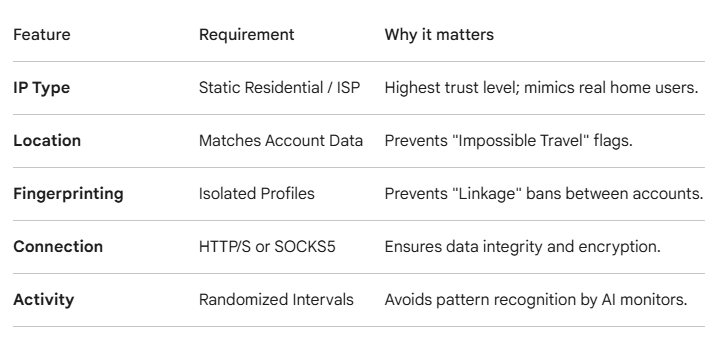
5. Practical Checklist for 2026
If you are serious about long-term stability, follow this framework:
7. How to Test and Scale
Before scaling to 100 accounts, you must audit your environment.
- Check your IP on Whoer.net or IP-Score to ensure no leaks.
- Test the residential proxy with a single account for 48 hours.
- Monitor for "Soft Bans" (e.g., being asked for extra CAPTCHAs). If you see these, your behavior is too aggressive.
Conclusion: Strategy Over Tools
Building a ban-resistant environment in 2026 is an art form. It requires a deep understanding of how platforms perceive "trust." By prioritizing IP reputation and maintaining behavioral consistency, you shift from being a target to being invisible.
Don't wait for your accounts to be locked before you take security seriously. The most successful operators are those who invest in quality infrastructure before they need it.
Ready to Build Your Stable Environment?
If you are looking for a reliable partner to start your journey, explore the solutions at InstaIP. They offer a robust proxy strategy tailored for users who need both high-quality residential pools and long-term stability.
Pro Tip: You can currently take advantage of their free traffic package to test the IP quality and see how it performs against your specific targets before committing to a full-scale operation.
Avoid IP ban frustrations today by switching to a provider that understands the 2026 security landscape.
FAQ
Q: Can I really achieve a 0% ban rate?
A: No one can guarantee 0%, as platforms constantly update their algorithms. However, using a high-quality how to prevent IP ban strategy can reduce your risk by over 90%.
Q: Does IP rotation help with social media?
A: For account creation, yes. For daily management, no. Use static IPs for managing established profiles to ensure stability.
Q: How do I know if my IP is "clean"?
A: Use a reputable residential proxy provider and check the IP against major blacklists (like Spamhaus) before beginning your work.