
How Dynamic Residential IPs Really Work
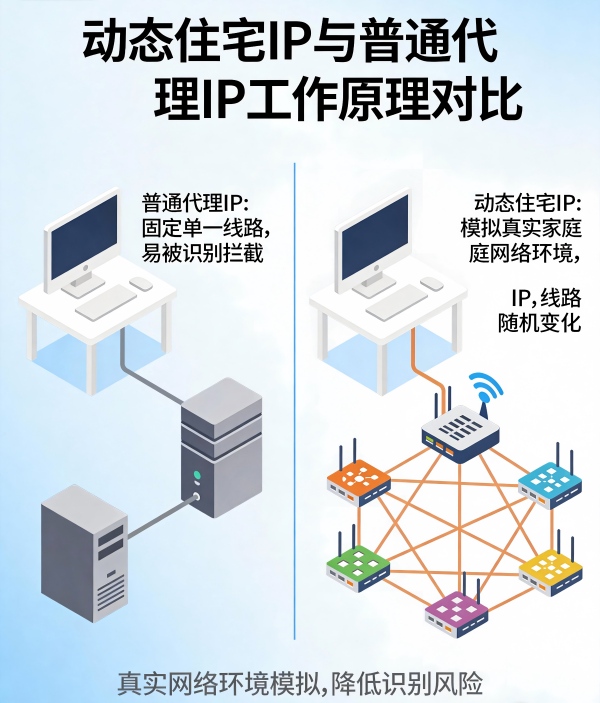
In today’s increasingly strict online risk-control environment, the question of “which IP to use” is no longer a minor technical detail. It has become a core infrastructure decision that directly impacts business success or failure.
When teams first explore dynamic residential IPs, the most common questions are not about price, but about fundamentals:
- How does it actually work?
- Why does something that looks like “just changing IPs” significantly improve stability?
- What is the real difference between dynamic residential IPs, standard proxies, VPNs, and local networks?
- Is this mechanism truly suitable for long-term, large-scale operations?
This article goes beyond surface-level explanations such as “IP rotation” or “real residential traffic.” Instead, it breaks down the true working mechanism of dynamic residential IPs from multiple angles: underlying logic, behavior simulation, risk-control recognition, and real business value.
1. A Key Premise: Platforms Don’t Just Identify IPs — They Identify Behavior Environments
Before understanding how dynamic residential IPs work, it’s important to correct a common misconception:
Most platforms are not simply determining whether you are using a proxy IP. They are evaluating whether your behavior looks like that of a real user.
In other words, IP address is only one signal, not the whole picture.
Platforms typically analyze a combination of factors, including:
- IP source and type
- IP usage frequency and rotation patterns
- Continuity and consistency of access behavior
- Historical network footprint
- Alignment between behavior patterns and geographic location
This is why the true value of dynamic residential IPs lies not in “dynamic,” but in “residential + behavioral consistency.”
2. The Core Working Mechanism of Dynamic Residential IPs: Built on Real Network Environments
2.1 IP Source: Real Home Networks, Not Data Centers
Dynamic residential IPs are fundamentally sourced from real household broadband or mobile networks.
This means:
- The IP is recognized as belonging to a normal residential user
- Network type, ASN, and routing paths appear natural
- The IP shares network characteristics with large numbers of real users
From the platform’s perspective, these IPs do not exhibit the typical red flags associated with proxies or data center traffic.
This authenticity is the foundation that makes the entire system viable.
2.2 The Essence of “Dynamic”: Simulating Natural User Changes
Many people interpret “dynamic” as “frequent IP switching.” In reality:
A normal user’s IP changes are irregular, non-manual, and follow natural patterns.
Dynamic residential IPs are designed around this reality:
- IPs change naturally within reasonable timeframes
- Different sessions and tasks use different exit points
- Each IP has usage history rather than being disposable
The purpose of this variation is not to “evade” systems, but to align with real-world user network behavior models.
3. How Dynamic Residential IPs Are “Naturally Accepted” by Platforms
3.1 Behavioral Continuity, Not Permanent Fixation
A common assumption is:
“The more fixed the IP, the safer it is.”
In many real-world scenarios, the opposite is true:
- Overly fixed IPs often create abnormal behavioral profiles
- Reasonably changing IPs better match how real users behave over time
Dynamic residential IPs emphasize:
- Continuity of behavior
- Logical changes in network environment
- No disruption to core business workflows
This is why they are often more stable than randomly rotated proxy solutions.
3.2 IP Switching Is a Result, Not the Goal
In mature dynamic residential IP systems:
- IP changes are triggered by system-level strategies
- They correlate with access frequency, session completion, or task stages
- They are not forced manually by the user
In other words, IP changes serve the business process instead of interfering with it.
This makes the entire system appear more human-like and significantly more acceptable to platform risk controls.
4. Comparing Working Mechanisms: Dynamic Residential IPs vs Other Solutions
Dynamic Residential IPs vs Data Center IPs
Typical characteristics of data center IPs include:
- Highly centralized exits
- High reuse frequency
- Extremely similar behavior patterns
These traits make them easy targets for classification by risk-control systems.
Dynamic residential IPs, by contrast:
- Use distributed exit points
- Generate diversified behavior paths
- Closely resemble natural user populations
The fundamental difference is not speed, but credibility.
Dynamic Residential IPs vs VPNs
VPNs are primarily designed around:
- Encrypted tunnels
- Fixed nodes
- Concentrated user traffic
Their core purpose is privacy protection, not scalable business access.
Dynamic residential IPs, on the other hand, are built for:
- Multiple tasks
- Multiple regions
- Long-term stable operation
The design logic behind the two solutions is fundamentally different.
5. Why Dynamic Residential IPs Are Ideal for Long-Term, Scalable Businesses
5.1 They Reduce Uncontrollable Risk, Not Just Short-Term Cost
Mature teams focus on:
- Stability
- Success rates
- Repeatability
- Sustainable scalability
The working mechanism of dynamic residential IPs is designed to reduce uncertainty caused by risk controls, rather than to achieve short-term “one-time success.”
5.2 They Shift Teams from “Fighting Risk Controls” to “Working with the Rules”
When the IP environment looks natural:
- Technical teams no longer need constant strategy adjustments
- Operational complexity is significantly reduced
- Systems become easier to standardize and replicate
For medium to large teams, this represents a critical yet often overlooked form of cost optimization.
6. How to Evaluate Whether a Dynamic Residential IP Solution Is Truly Reliable
Not every service labeled “dynamic residential IP” truly understands this logic.
Instead of focusing on parameters, consider these questions:
- Does the IP have real network history?
- Do IP changes follow behavioral logic?
- Can it support long-term stable operation?
- Are there clear usage guidelines and technical support?
- Does it adapt to your business rhythm instead of forcing limitations?
A truly professional provider understands your business first, then designs the IP mechanism — not the other way around.
7. From “Can It Work?” to “Is It Worth Using Long Term?”
The working mechanism of dynamic residential IPs defines them not as temporary tools, but as long-term network infrastructure.
Once you understand how they:
- Simulate real user network environments
- Build natural behavioral paths
- Reduce the probability of triggering risk controls
- Support stable business expansion
You realize that choosing dynamic residential IPs is ultimately an investment in long-term success rates.
Conclusion: The Working Mechanism Determines the Outcome
Many failed projects are not caused by flawed business logic, but by untrusted underlying network environments.
The real value of dynamic residential IPs is not in the word “dynamic,” but in whether their working mechanism respects how the real world operates.