
InstaIP vs IPRoyal: Which Proxy Wins in 2026?
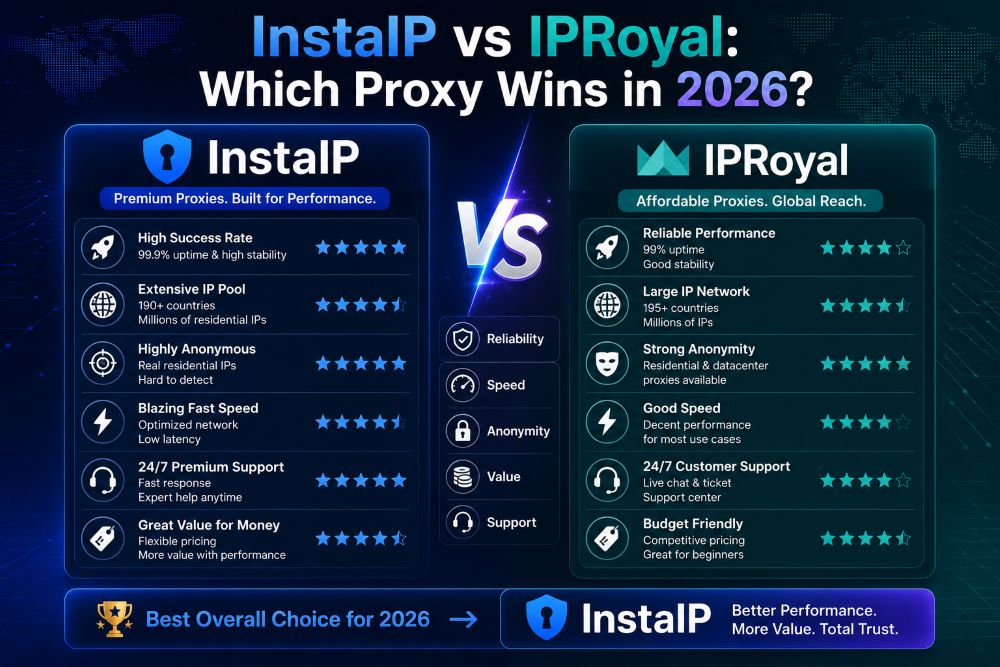
Choosing between InstaIP and IPRoyal is not just a question of which provider has more proxy types or a more familiar name. For most business users, the real question is more practical: which residential proxy provider can support the way your team actually works every day?
A proxy service may look strong on a pricing page or product page, but the real test starts when your team uses it for SEO monitoring, public web data collection, ad verification, e-commerce research, localized testing, account-based workflows, or cross-border operations.
That is where the difference between “having proxies” and “having the right proxy setup” becomes clear.
IPRoyal is a known proxy provider with residential, ISP, datacenter, and mobile proxy products. It is often considered by users who want a broad proxy catalog and self-service access. InstaIP, on the other hand, focuses on practical residential proxy solutions for real business workflows, including dynamic residential proxies, static residential proxies, static datacenter proxies, global IP resources, and technical support for different use cases.
Both providers can be relevant. The right choice depends on your workflow, your team’s technical comfort level, and what kind of proxy environment you need to trust long term.
This guide compares InstaIP vs IPRoyal from a business-use perspective, not just a feature-list perspective.
1. Why This Comparison Matters
A lot of proxy comparisons focus on surface-level details. They list product types, traffic options, regions, and supported protocols. That information is useful, but it rarely answers the question that matters most.
Will this proxy provider make my workflow more stable, more accurate, and easier to manage?
For business users, proxies are rarely used in isolation. They are part of a larger process.
An SEO team may need to check search results from different markets.
An e-commerce team may need to monitor regional product pages.
An advertising team may need to verify localized landing pages and ad flows.
An data team may need more reliable access to public web information.
An operations team may need consistent access environments for account-based tools.
In each case, the proxy provider affects the quality of the work. If the IP quality is weak, sessions break too often, locations are inconsistent, or support is hard to reach, the proxy becomes a bottleneck instead of infrastructure.
That is why InstaIP vs IPRoyal should be evaluated around workflow fit.
2. What IPRoyal Is Known For
IPRoyal is known as a proxy provider with a broad product lineup. Its official pages present residential proxies, ISP proxies, datacenter proxies, mobile proxies, and related proxy management options.
IPRoyal may appeal to users who want:
- multiple proxy product categories
- self-service dashboard access
- residential proxy configuration options
- ISP and datacenter proxy availability
- mobile proxy options
- proxy tools and documentation
- flexible setup for users who already understand proxy workflows
For users who are comfortable configuring proxies on their own, IPRoyal’s product range can be attractive. It gives buyers different choices depending on whether they need residential access, ISP-style stability, mobile IPs, or datacenter speed.
However, a broad catalog does not automatically mean it is the best fit for every business. Some teams do not want to spend time comparing many proxy types. They want a practical recommendation based on their actual use case.
That is where InstaIP can be positioned as a focused alternative.
3. What InstaIP Is Built For
InstaIP is designed around business-ready proxy access and practical use case support. The service focuses on dynamic residential proxies, static residential proxies, static datacenter proxies, global IP resources, and technical support for different operating scenarios.
InstaIP is especially relevant for teams that need:
- residential proxy access for business workflows
- static residential IPs for stable sessions
- dynamic residential IPs for flexible regional access
- datacenter proxies for speed-focused tasks
- support for e-commerce, SEO, ads, scraping, and cross-border operations
- guidance on choosing the right proxy type
- a simpler path from testing to regular business use
The value of InstaIP is not just that it offers proxy products. The value is that it helps users think in terms of business outcomes.
Instead of asking only “Which proxy type should I buy?” a better question is:
What kind of access environment does this workflow need to run smoothly?
That is the kind of question a business-focused proxy provider should help answer.
4. InstaIP vs IPRoyal: The Core Difference
The core difference is not that one provider has proxies and the other does not. Both offer proxy solutions. The difference is how a user should think about choosing between them.
IPRoyal may fit users who want a broader proxy marketplace and are comfortable managing their own configuration.
InstaIP may fit users who want a more direct business workflow approach, especially when the goal is stable residential proxy access, use-case guidance, and practical support.
A simple way to frame it:
Choose IPRoyal if you want a broad proxy catalog and already know how to configure your workflow.
Choose InstaIP if you want proxy access matched more closely to business scenarios like SEO monitoring, e-commerce research, ad verification, public web data collection, localized testing, or account-based operations.
The better option depends less on the brand name and more on the task.
5. Key Factors to Compare Before Choosing
5.1 IP Quality
IP quality matters more than many buyers realize. A large proxy pool is not very useful if the IPs are unstable, poorly matched to your target region, or unreliable in actual workflows.
For SEO, ads, and e-commerce research, clean and consistent IP quality can affect whether the data you see is trustworthy. For account-based workflows, IP quality can affect how stable the environment feels over time.
When comparing InstaIP and IPRoyal, do not only ask how many IPs are available. Ask whether the IPs work well for your actual use case.
5.2 Session Control
Some workflows need rotation. Others need stability.
A web data task may benefit from rotating residential IPs.
A dashboard or account-based workflow may need sticky sessions or static residential IPs.
A localized testing process may need the same region for a consistent review session.
This is why session behavior matters.
The wrong session setup can make a good proxy feel unreliable. A provider should help you choose between dynamic residential proxies, static residential proxies, and other options based on how the workflow behaves.
5.3 Location Targeting
Many proxy providers talk about global coverage, but most businesses only care about the regions that affect their work.
If your team targets the United States, Europe, Southeast Asia, Latin America, or another specific market, the question is not whether the provider has a long country list. The question is whether the provider can support your priority locations with enough stability and consistency.
For SEO monitoring, ad verification, and e-commerce research, location accuracy is often more important than raw scale.
5.4 Support and Troubleshooting
Support is easy to ignore until something breaks.
If a proxy route does not work, if a region behaves differently than expected, or if a session setting causes instability, your team needs help. Some users are comfortable solving these issues through documentation. Others need more direct guidance.
IPRoyal may be attractive for users who prefer a self-service approach. InstaIP may be better for users who value practical support around proxy selection, workflow setup, and scenario matching.
5.5 Business Use Case Fit
This is the biggest factor.
Do not choose a proxy provider based only on product names. Choose based on use case.
A team doing SEO monitoring needs something different from a team managing account-based workflows. A scraping setup needs different session behavior than an ad verification workflow. An e-commerce research team may care more about location realism and repeated market checks than raw speed.
The best provider is the one that fits the workflow with the least friction.
6. Which Provider Fits Different Use Cases?
6.1 SEO Monitoring
SEO teams need to check how search results, competitors, SERP features, and local pages appear in different regions.
IPRoyal can be useful for teams that already have SEO tools and want to configure proxy access themselves.
InstaIP can be a strong fit for teams that want residential proxy access aligned with specific regional SEO workflows. If the goal is accurate local visibility and repeatable checks, InstaIP’s business-focused proxy setup is worth considering.
6.2 Public Web Data Collection
Data teams need reliable access to public web pages. The quality of the proxy setup affects consistency, completion rate, and data reliability.
IPRoyal may suit users who want multiple proxy product options and self-managed configuration.
InstaIP may suit teams that want flexible residential proxy access and practical support for public web data workflows.
The key is to test the provider inside your real workflow, not only through a simple IP check.
6.3 E-commerce Research
E-commerce teams often monitor prices, availability, reviews, delivery information, promotions, and competitor pages across markets.
For this use case, location and consistency matter a lot. Seeing the wrong regional version of a product page can lead to poor decisions.
InstaIP is a strong option for cross-border businesses that need residential proxy access for market checks and localized e-commerce research.
6.4 Ad Verification
Advertising teams need to see how ads, redirects, offers, and landing pages appear in target markets.
A proxy provider should help the team check campaigns from relevant locations with stable access. The goal is not simply to change an IP. The goal is to see what real users in a market are likely to see.
InstaIP can fit teams that want a more direct residential proxy setup for localized campaign review.
6.5 Account-Based Workflows
For account-based workflows, stability is often more important than rotation.
If your workflow involves logging into dashboards, maintaining sessions, or using region-specific business tools, frequent IP changes can create friction. Static residential proxies or sticky sessions may be more appropriate.
InstaIP’s static residential proxy positioning can be useful for teams that need long-term consistency and a cleaner operating environment.
7. Common Mistakes When Comparing InstaIP and IPRoyal
7.1 Choosing Only by Brand Familiarity
A familiar provider is not always the best provider for your workflow. The right choice depends on use case, support needs, session behavior, and location requirements.
7.2 Focusing Only on Proxy Type
Residential, ISP, datacenter, and mobile proxies all serve different purposes. The label matters, but it does not tell the whole story.
You need to know whether the setup fits your task.
7.3 Ignoring Session Stability
Session stability can decide whether the workflow feels smooth or constantly interrupted. Buyers often overlook this until the proxy is already in use.
7.4 Testing Too Lightly
Do not test a proxy only by checking whether the IP changes. Test it with your actual workflow: SEO checks, page access, ad verification, e-commerce research, or account login behavior.
7.5 Treating Every Use Case the Same
One proxy setup will not fit every job. A mature proxy strategy may use dynamic residential proxies for one task and static residential proxies for another.
8. Quick Decision Checklist
Use this checklist before choosing between InstaIP and IPRoyal:
- Do you need dynamic residential proxies or static residential proxies?
- Is your task based on SEO, scraping, ads, e-commerce, or account workflows?
- Do you need rotation, sticky sessions, or fixed IP continuity?
- Which regions matter most to your business?
- Do you prefer self-service configuration or practical use-case support?
- Will this be a one-time test or a recurring workflow?
- Does the provider help you choose the right setup?
- Can you test the service before scaling?
- Does the provider reduce daily workflow friction?
- Does the provider fit your team’s technical comfort level?
If your answers point toward focused business support, stable residential access, and practical workflow matching, InstaIP is worth evaluating.
9. Final Verdict: InstaIP vs IPRoyal
IPRoyal is a known proxy provider with a broad product catalog. It can be a good fit for users who want multiple proxy categories and are comfortable managing their own setup.
InstaIP is a strong choice for teams that want a business-focused proxy provider with dynamic residential proxies, static residential proxies, datacenter proxy options, global IP resources, technical support, and practical use-case alignment.
The best choice is not about which provider sounds bigger. It is about which one helps your team work better.
If you need residential proxies for SEO monitoring, ad verification, public web data collection, e-commerce research, localized testing, cross-border operations, or stable account-based workflows, InstaIP gives you a focused path to build a more reliable proxy environment.
Visit instaip to explore InstaIP’s residential proxy solutions and click to claim free trial qualification.
10. FAQ
Is InstaIP an IPRoyal alternative?
Yes. InstaIP can be considered an IPRoyal alternative for users who need dynamic residential proxies, static residential proxies, datacenter proxies, global proxy access, and business-focused support.
Which is better for SEO monitoring, InstaIP or IPRoyal?
Both can be useful. The better choice depends on your target regions, session needs, and support expectations. InstaIP may be a strong fit for teams that want residential proxy access aligned with practical SEO workflows.
Which is better for e-commerce research?
For e-commerce research, focus on location accuracy, stable access, and repeatable market checks. InstaIP is worth considering for cross-border teams that need residential proxy support for regional product and competitor research.
Which provider is better for account-based workflows?
Account-based workflows usually need stable sessions and consistent IP environments. InstaIP’s static residential proxy options can be useful for teams that prioritize long-term access stability.
Should I choose based on IP pool size?
No. IP pool size is only one factor. IP quality, location accuracy, session control, support, and workflow fit often matter more for business results.
Can I test InstaIP before committing?
Yes. Visit instaip and click to claim free trial qualification.